AI Governance Framework: Navigating the AI Privacy Impact Assessment in Australia

What if the greatest threat to your AI strategy was not the technology itself, but the disconnect between executive expectations and how AI is being deployed across the organisation? This is a challenge facing many Australian businesses as they seek to embrace innovation while maintaining strong governance, regulatory compliance, and stakeholder confidence.
Artificial intelligence presents significant opportunities to improve efficiency, support decision making, and create new sources of value. At the same time, it introduces risks that traditional governance processes were not designed to manage. Questions around data quality, privacy obligations, model behaviour, vendor accountability, and transparency are now business issues that require executive oversight.
The Privacy and Other Legislation Amendment Act 2024 has increased expectations around privacy governance, while additional transparency requirements for automated decision making are expected to take effect in December 2026. As a result, organisations need a structured approach that balances innovation with accountability.
This article explains how an AI privacy impact assessment Australia organisations can rely on helps identify risks, strengthen governance, and support responsible AI adoption. You will learn what a mature assessment process looks like, how it supports regulatory readiness, and why it has become an important part of modern business governance.
Key Takeaways
- Understand why traditional privacy assessments are often insufficient for AI systems.
- Learn the key elements of an AI privacy impact assessment Australia organisations can use to improve transparency and accountability.
- Align executive risk expectations with operational implementation through effective governance structures.
- Discover how an AI maturity assessment can help identify significant risks and map current AI usage.
- Build stakeholder confidence by embedding privacy and governance into every stage of the AI lifecycle.
Table of Contents
- The Strategic Role of the AI Privacy Impact Assessment in Australian Governance
- Key Components of an Effective AI Privacy Impact Assessment
- Turning AI Governance into an Operational Practice
The Strategic Role of the AI Privacy Impact Assessment in Australian Governance
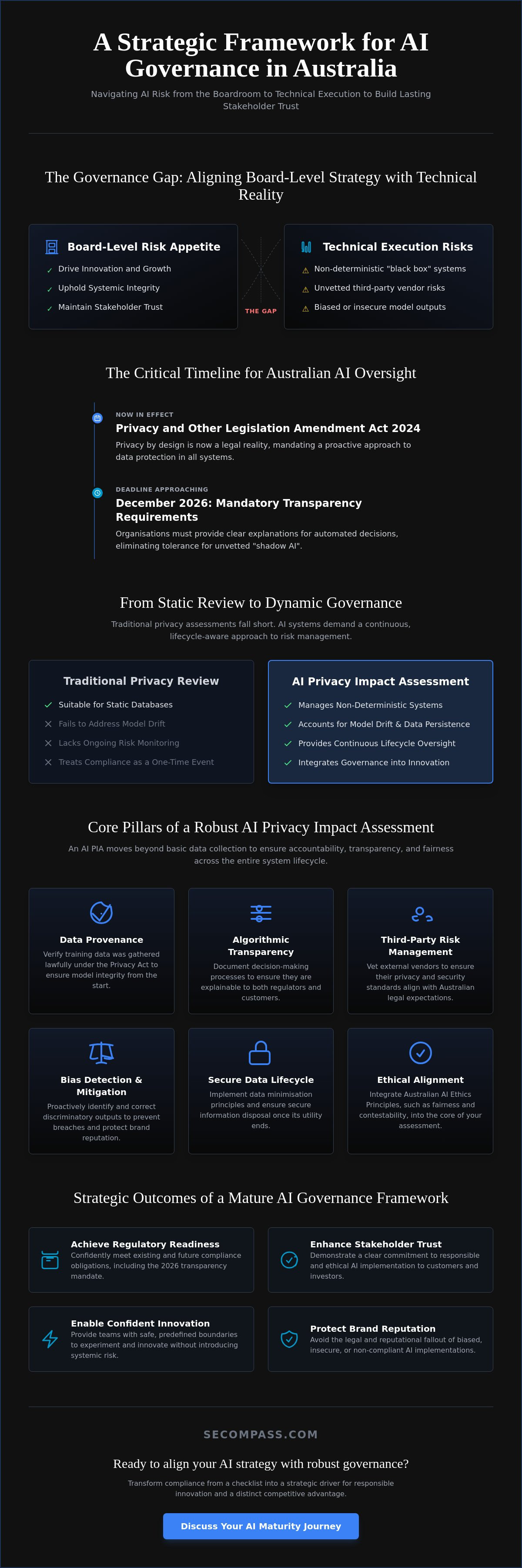
An AI privacy impact assessment Australia organisations undertake should be viewed as more than a compliance activity. It is a structured process that helps identify, assess, and manage privacy risks throughout the lifecycle of an AI system.
Traditional privacy assessments were designed for relatively static technologies. AI systems introduce additional complexity. Models can evolve over time, consume new data, produce unexpected outcomes, and generate decisions that may be difficult to explain without appropriate controls and documentation.
For boards and executive teams, an AI privacy impact assessment provides a clearer understanding of how AI systems operate, where risks exist, and what safeguards are required. It supports informed decision making and helps ensure that AI initiatives remain aligned with organisational values, regulatory obligations, and customer expectations.
When conducted properly, an assessment can identify issues before they become operational, legal, or reputational problems. It also creates a stronger foundation for responsible innovation by ensuring risks are considered early rather than after deployment.
Why 2026 Matters for AI Governance
Australia's regulatory environment continues to evolve in response to rapid advances in artificial intelligence.
The Privacy and Other Legislation Amendment Act 2024 has reinforced expectations around privacy governance and accountability. At the same time, transparency requirements relating to automated decision making are expected to become increasingly important as regulators seek greater visibility into how organisations use AI.
These developments create additional pressure on organisations to understand where AI is being used and how decisions are being made. Many businesses are also discovering the challenge of unauthorised AI adoption, where employees use AI tools without formal review or governance oversight.
Without visibility into these activities, organisations may expose sensitive information, create privacy risks, or breach internal policies without realising it.
Supporting Innovation Through Governance
Good governance should not slow innovation. It should create the conditions that allow innovation to occur safely and responsibly.
A well designed AI governance framework helps teams understand acceptable risk levels, establish clear decision making processes, and apply appropriate controls. This allows employees to explore new technologies with confidence while ensuring that organisational standards are maintained.
Strong governance also demonstrates accountability to customers, regulators, investors, and business partners. In an environment where trust is increasingly important, this can become a meaningful competitive advantage.
Key Components of an Effective AI Privacy Impact Assessment
A comprehensive AI privacy impact assessment Australia organisations implement should examine far more than how personal information is collected and stored.
One of the most important considerations is data provenance. Organisations need confidence that training data has been collected lawfully and that its use complies with applicable privacy obligations. Poor quality or improperly sourced data can undermine the reliability of an AI system and create significant compliance risks.
Transparency is another critical component. Organisations should be able to explain how an AI system reaches outcomes, particularly when those outcomes influence customers, employees, or important business decisions.
Vendor governance also plays a major role. Many organisations rely on external providers for AI platforms, models, or supporting infrastructure. Understanding how those vendors manage privacy, security, and compliance is essential to maintaining control over risk.
Bias detection and monitoring should also form part of the assessment process. AI systems can unintentionally produce unfair or inconsistent outcomes. Regular review helps organisations identify issues early and take corrective action before they affect customers or damage reputation.
Aligning with Australian AI Ethics Principles
Australia's AI Ethics Principles provide a useful framework for organisations seeking to adopt AI responsibly.
Principles such as fairness, transparency, accountability, privacy protection, and contestability should be reflected throughout the assessment process. Rather than treating ethics as a separate exercise, mature organisations integrate these principles directly into governance, risk management, and decision making.
This approach helps bridge the gap between legal compliance and broader stakeholder expectations.
Managing the AI Data Lifecycle
Data management remains one of the most important aspects of AI governance.
Organisations should collect only the information required for a legitimate purpose, retain it only as long as necessary, and ensure it is protected throughout its lifecycle.
Maintaining this level of oversight can be challenging, particularly for organisations operating across multiple systems, jurisdictions, and business units. Many organisations engage a Virtual Data Protection Officer to help oversee privacy obligations and strengthen governance across complex environments.
Turning AI Governance into an Operational Practice
Effective governance requires more than policies and documentation. It requires a practical operating model that connects executive oversight with day to day implementation.
A useful starting point is an AI maturity assessment. This helps organisations understand where AI is currently being used, identify areas of concern, and establish priorities for improvement.
Many organisations are surprised to discover the extent of AI usage that exists outside formal governance processes. Mapping this activity provides the visibility needed to manage risk effectively.
Establishing an AI Steering Committee can further strengthen oversight. Representatives from legal, risk, technology, privacy, and executive leadership should work together to review significant initiatives and provide direction on governance priorities.
Policies should clearly define risk thresholds, approval requirements, accountability responsibilities, and assessment criteria. Employees should understand when formal review is required and who is responsible for decision making.
The Role of Virtual CISO and Virtual DPO Services
Many organisations do not require permanent executive appointments to establish strong AI governance.
Virtual CISO and Virtual DPO services provide access to experienced advisors who can help organisations develop governance frameworks, assess risks, and strengthen oversight.
These advisors bring an independent perspective and can help translate technical issues into business impacts that executives and boards can readily understand.
Their involvement often improves communication between stakeholders while ensuring governance activities remain practical and aligned with organisational objectives.
Building Confidence Through Ongoing Oversight
AI governance should be viewed as an ongoing business discipline rather than a single project.
Regular reporting helps leadership understand how AI systems are performing, whether risks are being managed effectively, and where additional action may be required.
Governance processes should evolve alongside technology, business priorities, and regulatory expectations. Organisations that maintain this focus are better positioned to adapt to change while preserving trust and accountability.
Strengthening Trust Through Responsible AI Governance
As AI becomes more deeply embedded within business operations, governance can no longer be treated as an optional consideration. Organisations need clear processes that support innovation while protecting privacy, managing risk, and maintaining stakeholder confidence.
A structured AI privacy impact assessment Australia organisations can rely on provides the visibility needed to understand how AI systems operate, where risks exist, and what controls are required. It helps leadership make informed decisions while ensuring AI initiatives remain aligned with business objectives and regulatory expectations.
Our advisory team helps organisations across Australia and New Zealand build practical governance frameworks that support responsible AI adoption. Through Virtual CISO and Virtual DPO services, we help leadership teams strengthen oversight, improve accountability, and create a sustainable foundation for future innovation.
If you are preparing for the next stage of your AI journey, we invite you to discuss your cybersecurity and AI governance maturity with our team.
Frequently Asked Questions
Is an AI privacy impact assessment mandatory in Australia?
While not every AI project requires a formal assessment, organisations using AI systems that process personal information should strongly consider conducting one. Assessments help demonstrate accountability, identify privacy risks, and support compliance with evolving regulatory expectations.
How is an AI privacy impact assessment different from a standard privacy impact assessment?
An AI privacy impact assessment considers risks that are unique to artificial intelligence, including model behaviour, transparency, bias, training data quality, and ongoing changes in system performance. Traditional assessments generally focus on information handling practices and may not fully address these issues.
What are the risks of deploying generative AI without governance?
Without governance, organisations may expose sensitive information, create privacy breaches, rely on inaccurate outputs, or introduce bias into business processes. A lack of oversight can also increase legal, regulatory, and reputational risk.
How often should AI privacy assessments be reviewed?
Assessments should be reviewed whenever there is a significant change to the AI system, its purpose, its data sources, or the regulatory environment. As a general practice, an annual review helps ensure governance remains effective and aligned with current requirements.

Article by
Jatinder Oberoi
Founder and Principal Consultant at SeComPass, a cybersecurity, privacy, governance, and compliance advisory firm supporting organisations across Australia and New Zealand. With extensive experience in cybersecurity leadership, risk management, ISO 27001, SOC 2, privacy, and governance advisory, he works closely with executive teams to help organisations strengthen operational resilience and improve cybersecurity maturity. Known for his pragmatic and business-focused approach, Jatinder specialises in translating complex cybersecurity and compliance challenges into clear, actionable strategies for leadership teams. His work focuses on helping organisations align security initiatives with business objectives, governance expectations, regulatory obligations, and long-term resilience outcomes. Through SeComPass, he regularly advises organisations on cybersecurity governance, AI risk, third-party risk, compliance frameworks, security leadership, and enterprise resilience. His writing and advisory approach emphasises clarity, practical decision-making, and sustainable security maturity over fear-driven cybersecurity messaging.