Data Breach Response Plan Australia: A Strategic Governance Framework for 2026

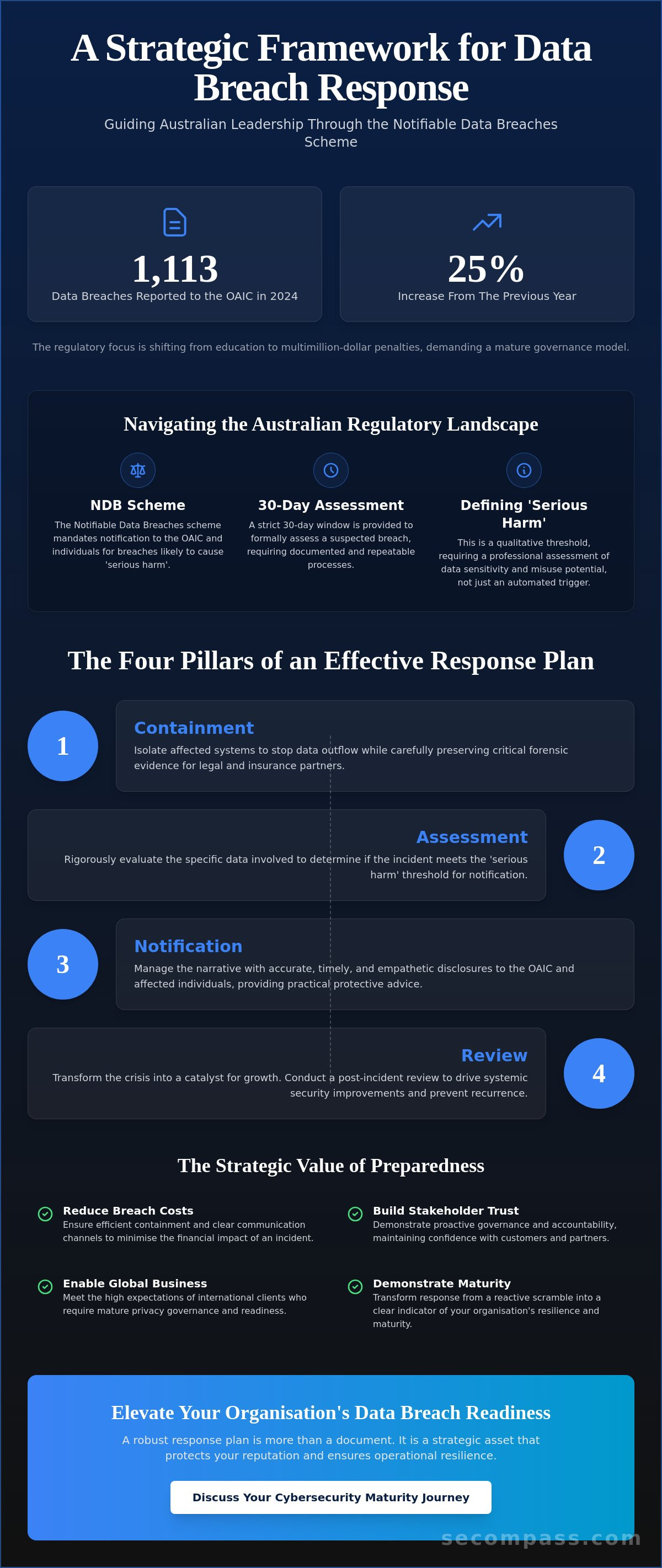
With 1,113 data breaches reported to the OAIC in 2024, a 25% increase from the previous year, the challenge for Australian boards is no longer just a technical one. You likely feel the weight of the Notifiable Data Breaches (NDB) scheme and the pressure to maintain a robust data breach response plan australia during a public incident. It's natural to worry about whether your internal team has the specific expertise to lead a high-pressure response when every minute counts. We understand that navigating the shift from an education-first regulator to one that issues multimillion-dollar penalties requires more than just a basic IT policy.
This executive guide provides a clear, executable roadmap for building a strategic framework that is both compliant and aligned with your business goals for 2026. We will move beyond basic checklists to establish a governance model that satisfies the Privacy Act and builds genuine board-level confidence. You will learn how to transform your incident response from a reactive scramble into a disciplined, mature operation that maintains stakeholder trust and ensures long-term operational resilience.
Key Takeaways
- Understand the nuances of the Notifiable Data Breaches (NDB) scheme and how to professionalise the assessment of 'serious harm' to meet evolving regulatory expectations.
- Learn how to develop a data breach response plan australia that serves as a strategic governance tool rather than a simple technical checklist.
- Discover how to implement immediate containment strategies that secure your digital environment without compromising vital forensic evidence.
- Identify the benefits of transitioning from a static document to a resilient security culture through regular, executive-led tabletop exercises.
- Gain insights into how consistent stewardship transforms incident response from a reactive event into a clear indicator of your organisation's maturity.
Navigating the Australian Regulatory Landscape and the NDB Scheme
The Notifiable Data Breaches (NDB) scheme serves as the primary governance framework for privacy in Australia. It mandates that organisations notify both the Office of the Australian Information Commissioner (OAIC) and affected individuals when a breach is likely to result in serious harm. Unlike simple technical errors, the concept of serious harm is a qualitative threshold. It requires a professional assessment of the data's sensitivity and the potential for misuse, rather than relying on automated triggers. Australia has established specific data breach notification laws that prioritise transparency and individual protection. Engaging with the OAIC transparently is a strategic choice. It demonstrates that your leadership prioritises accountability. Ultimately, a well-structured data breach response plan australia is a clear indicator of your organisation's cybersecurity maturity to stakeholders and global partners.
Understanding Your Obligations Under the Privacy Act
The Privacy Act 1988 captures most Australian businesses with an annual turnover exceeding $3 million, along with all private sector health providers and credit reporting bodies. Once you suspect an eligible data breach has occurred, the law provides a 30-day window to complete a formal assessment. This period isn't a buffer for delay. It's a timeframe for acting with deliberate speed to contain the incident and mitigate harm. Leadership must ensure that this assessment process is documented and repeatable to withstand regulatory scrutiny.
The Strategic Value of Preparedness
Beyond compliance, preparedness offers tangible business outcomes. An effective plan acts as a tool for reducing the total cost of a breach by ensuring efficient containment and clear communication channels. In an environment where consumer trust is fragile, showing that you've prepared for the worst builds lasting confidence. This level of readiness is particularly valuable when negotiating with international clients who expect a high degree of privacy governance. A data breach response plan australia ensures that when an incident occurs, your team responds with composure rather than confusion.
Constructing Your Data Breach Response Plan: The Four Pillars of Action
A resilient data breach response plan australia is built on four distinct, interconnected phases that move your organisation from initial shock to long-term stability. The first pillar is immediate containment. This involves isolating affected systems and stopping the data outflow. It's a delicate balance; you must neutralise the threat without accidentally destroying logs or forensic evidence that your legal and insurance partners will eventually require. The second pillar is rigorous assessment. During this stage, your team evaluates the specific data sets involved and determines if the incident is likely to result in serious harm to individuals.
The third pillar focuses on strategic notification. This is where leadership manages the narrative, ensuring that disclosures are accurate and timely. Finally, the fourth pillar is the post-incident review. This stage is often overlooked, yet it's the most critical for growth. It involves turning the crisis into a catalyst for systemic security improvement, ensuring that the same vulnerabilities are never exploited twice.
Establishing the Response Team and Lines of Authority
A successful response depends on a multidisciplinary team that includes legal counsel, IT specialists, communications experts, and executive leadership. Clear lines of authority must be established before an incident occurs to prevent confusion during high-pressure moments. Many organisations find significant value in engaging a Virtual CISO to lead this coordination. This role provides the strategic oversight and technical expertise needed to bridge the gap between technical teams and the board, ensuring that every decision aligns with your broader risk management goals.
Notification Strategies for Australian Stakeholders
When a breach meets the criteria of the Notifiable Data Breaches (NDB) scheme, you have a legal obligation to inform both the OAIC and the affected individuals. Your communication should be clear, empathetic, and practical. It's not enough to simply state that a breach occurred; you must provide actionable advice on how individuals can protect themselves. This transparency helps maintain trust and demonstrates that your organisation takes its privacy obligations seriously. If you're unsure how to structure your internal governance for these moments, you may wish to discuss your cybersecurity maturity journey with a dedicated advisor.
Elevating Readiness Through Strategic Leadership and Ongoing Governance
A static document is often a liability because it fails to account for the fluid nature of modern threats. Transitioning to a living security culture ensures that your response capabilities evolve alongside your business operations. Board oversight is essential here. Directors must view a data breach response plan australia as a fundamental component of corporate governance rather than a peripheral IT concern. While the OAIC provides the four key steps to data breach response, the effectiveness of these actions depends entirely on the maturity of your internal leadership.
Regular tabletop exercises are the most effective way to validate your preparedness. These sessions simulate the intense pressure of a real incident, allowing your team to identify gaps in communication and authority before a crisis occurs. For organisations seeking continuous alignment with shifting regulatory expectations, Privacy as a Service (PaaS) offers a structured way to maintain compliance without the overhead of a full-time internal department.
The Role of the Virtual DPO and CISO in Response Planning
A Virtual Data Protection Officer ensures your plan remains compliant with the latest OAIC guidance and global best practices. During the 'fog of war' that follows a breach, having an external, objective expert is invaluable. They provide a calm, steadying perspective that helps leadership make logical decisions when internal teams might be overwhelmed by the high-pressure environment of a live incident.
Integrating Breach Response into Your Broader Security Strategy
Your response plan should not exist in isolation. Linking it to international frameworks like ISO 27001 ensures global consistency and operational rigour. In the Australian market, a mature response capability is a significant competitive differentiator. It signals to your partners and clients that you are a reliable steward of their most sensitive data. To ensure your organisation is prepared for the challenges of 2026, we invite you to discuss your cybersecurity maturity journey with our advisory team.
Strengthening Organisational Resilience Through Strategic Oversight
Developing a mature response capability requires a fundamental shift in perspective. It is about moving from viewing security as a series of technical hurdles to recognising it as a vital pillar of corporate governance. We have explored how a robust data breach response plan australia integrates the four pillars of action with ongoing executive commitment. By replacing static documents with active, simulated readiness, your organisation can protect its reputation while satisfying the rigorous demands of the OAIC and international stakeholders.
SeComPass provides the specialised vCISO and vDPO leadership required to navigate these complexities with professional composure. Our expert advisory services for ISO 27001, SOC2, and NIST are designed to turn compliance into a strategic business enabler. With dedicated offices in Melbourne and Auckland, we offer the grounded, practical assistance needed to guide your leadership team through every stage of the maturity landscape. We look forward to supporting your progress as you build a more secure and resilient future.
We invite you to speak with our experts to discuss your cybersecurity maturity journey.
Frequently Asked Questions
What is a data breach response plan under Australian law?
A data breach response plan is a strategic framework that outlines the procedures an entity must follow to manage a suspected or actual compromise of personal information. It serves as a practical guide for leadership to ensure that every action taken complies with the Privacy Act 1988 while minimising the impact on individuals. This document establishes clear roles and responsibilities, ensuring that your organisation can respond with composure and precision during a high-pressure incident.
Is it mandatory for Australian businesses to have a data breach response plan?
While the Privacy Act does not explicitly mandate a written document for all entities, the OAIC considers having a data breach response plan australia as a core component of meeting your legal obligations under Australian Privacy Principle 11. Without a formalised plan, it's nearly impossible for an organisation to meet the rigorous assessment and notification timelines required by the Notifiable Data Breaches (NDB) scheme. A documented plan is often viewed by regulators as evidence of cybersecurity maturity and proactive risk management.
What are the four steps of the OAIC data breach response framework?
The OAIC framework consists of four critical steps: containment, assessment, notification, and review. This methodical approach ensures that the initial threat is neutralised before a detailed evaluation of the potential harm to individuals is conducted. Following these steps allows leadership to maintain a disciplined response that prioritises transparency. It also ensures that every incident is treated as an opportunity for systemic improvement, rather than just a technical failure to be resolved.
How quickly must I notify the OAIC if a data breach occurs?
You must notify the OAIC as soon as practicable after you determine that an eligible data breach has occurred. The law provides a maximum of 30 calendar days to complete a formal assessment once you become aware of a suspected breach. If the assessment confirms that the incident is likely to result in serious harm, notification to the regulator and affected individuals should be initiated without delay. Acting with deliberate speed is essential to satisfy regulatory expectations and protect your brand's reputation.

Article by
Jatinder Oberoi
Founder and Principal Consultant at SeComPass, a cybersecurity, privacy, governance, and compliance advisory firm supporting organisations across Australia and New Zealand. With extensive experience in cybersecurity leadership, risk management, ISO 27001, SOC 2, privacy, and governance advisory, he works closely with executive teams to help organisations strengthen operational resilience and improve cybersecurity maturity. Known for his pragmatic and business-focused approach, Jatinder specialises in translating complex cybersecurity and compliance challenges into clear, actionable strategies for leadership teams. His work focuses on helping organisations align security initiatives with business objectives, governance expectations, regulatory obligations, and long-term resilience outcomes. Through SeComPass, he regularly advises organisations on cybersecurity governance, AI risk, third-party risk, compliance frameworks, security leadership, and enterprise resilience. His writing and advisory approach emphasises clarity, practical decision-making, and sustainable security maturity over fear-driven cybersecurity messaging.