Developing a Robust Vendor Security Review Process: An Executive Guide

Board members are increasingly demanding proof of supply chain resilience, yet 60% of data breaches in 2025 involved a third party. You likely find the current volume of questionnaires overwhelming and the lack of visibility into partner data handling deeply concerning. We understand that a traditional vendor security review process often feels like a compliance hurdle that slows down operations. This guide will show you how to transform these reviews into a strategic governance framework that protects your business and enables growth. We will explore how to build a scalable review model that aligns with ISO 27001 or SOC 2 standards, providing you with genuine confidence in the security posture of your entire business ecosystem.
Key Takeaways
- Learn to align your vendor security review process with strategic business goals to eliminate compliance fatigue and focus on genuine risk reduction.
- Discover how to categorise and tier your partners based on data access and criticality, ensuring your resources are focused where they matter most.
- Streamline evidence collection by leveraging established standards such as ISO 27001 and SOC 2 reports to maintain a consistent and professional audit trail.
- Shift from static, point-in-time assessments to a model of continuous relationship monitoring that supports long-term operational resilience.
- Adopt Corrective Action Plans to foster a culture of collaborative improvement within your supply chain, strengthening the security posture of your entire business ecosystem.
Establishing a Governance-First Approach to Vendor Security
A robust vendor security review process is far more than a technical hurdle. It represents a strategic alignment between your organisation's operational requirements and the specific capabilities of your third-party partners. For many executives, the traditional approach involves a mountain of spreadsheets and generic questionnaires. This method often leads to compliance fatigue, where teams focus on finishing the task rather than identifying critical risks. It creates a false sense of security while leaving the backdoor open to systemic vulnerabilities.
In the Australian and New Zealand markets, the stakes for supply chain resilience have never been clearer. A breach within your vendor ecosystem doesn't just impact your data; it erodes customer trust and can cause lasting damage to your brand reputation. This is why leading organisations no longer view security as a cost centre. Instead, they treat it as a strategic enabler. By establishing a mature governance framework, you position your business to achieve ISO 27001 or SOC 2 certification. These milestones open doors to larger enterprise contracts and global markets by providing verifiable assurance to your partners.
While many organisations still rely on a basic Vendor Management System to track procurement and logistics, these platforms often lack the depth required for modern risk oversight. True governance requires a shift from administrative tracking to proactive stewardship, ensuring that every external partnership strengthens your security posture rather than diluting it.
Aligning with Australian and New Zealand Regulatory Expectations
Regulatory bodies are increasingly focusing on how businesses manage their external partners. In Australia, APRA CPS 234 mandates that regulated entities maintain a level of security across their entire supply chain that is proportionate to the threats they face. Across the Tasman, the NZ Privacy Act 2020 places clear accountability on organisations to ensure that personal information remains protected when shared with service providers, regardless of where that data resides.
Integrating privacy impact assessments into your initial vendor discovery phase is a fundamental requirement for maintaining compliance. Managing these complexities requires specialised expertise that balances regulatory demands with business velocity. Many leadership teams utilise Virtual CISO services to maintain this alignment. This approach provides executive-level guidance and strategic oversight without the significant overhead and recruitment challenges associated with a full-time hire. It allows your business to remain agile while ensuring your vendor ecosystem remains resilient and compliant.
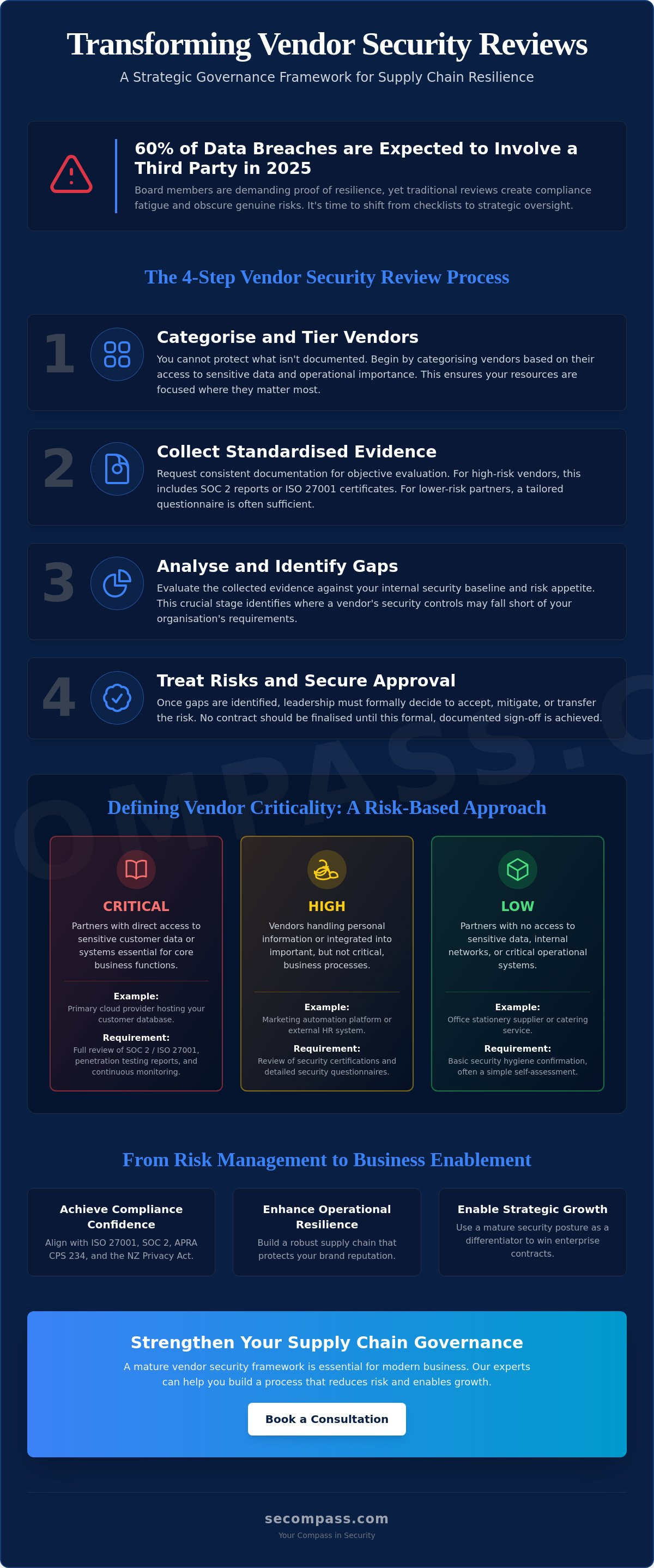
A Step-by-Step Guide to the Vendor Security Review Process
Implementing a structured vendor security review process allows your leadership team to move away from reactive fire-fighting and towards a methodical, risk-based approach. By following a repeatable series of steps, you ensure that every third-party relationship is scrutinised with the same level of professional rigour. Adopting this structured methodology ensures alignment with global benchmarks such as the NIST Cybersecurity Framework (CSF) 2.0, which prioritises governance and supply chain risk management as core business functions.
- Step 1: Inventory and Tiering. You cannot protect what you haven't documented. Begin by categorising your vendors based on their access to sensitive data and their importance to your daily operations. This ensures your team focuses its limited resources on the partners that pose the greatest potential risk.
- Step 2: Standardised Evidence Collection. Requesting consistent documentation is essential for objective evaluation. For high-risk vendors, this typically involves reviewing SOC 2 reports or ISO 27001 certificates. For lower-risk entities, a tailored questionnaire may be sufficient to verify their basic security hygiene.
- Step 3: Analysis and Gap Identification. Evaluate the collected evidence against your internal security baseline. It is during this stage that you identify where a vendor’s controls fall short of your organisation's risk appetite.
- Step 4: Risk Treatment and Approval. Once gaps are identified, leadership must decide whether to accept the risk, request specific mitigations before signing, or transfer the risk through contractual indemnities. No contract should be finalised until this formal sign-off is achieved.
Defining Criticality and Risk Appetite
Establishing clear definitions for vendor criticality is the foundation of an efficient programme. A "Critical" vendor might be a cloud provider hosting your primary customer database, while a "Low" risk vendor could be a stationery supplier with no network access. Setting a "minimum viable security" threshold ensures that any partner failing to meet basic standards is flagged early in the procurement cycle. If you would like to discuss your cybersecurity maturity journey and how to set these thresholds, our advisors can provide tailored guidance for your sector.
Streamlining Due Diligence for SaaS and Cloud Providers
SaaS security presents unique challenges, particularly regarding data residency and sub-processor oversight. It is vital to confirm where your data will physically reside to remain compliant with Australian and New Zealand privacy laws. Many organisations find value in engaging a Virtual Security Compliance Officer (vSCO) to manage these technical evaluations. This support ensures that complex areas like encryption at rest and multi-tenant isolation are reviewed by experts, allowing your internal team to focus on core business objectives.
Advancing from Compliance Checklists to Strategic Maturity
True maturity in a vendor security review process is marked by a transition from static, point-in-time audits to a model of continuous stewardship. While an annual check provides a snapshot of a partner's posture, it cannot account for the rapid changes in the threat landscape or a vendor's internal architectural shifts. By evolving your approach, you move beyond the "pass or fail" mentality that often stalls procurement and instead foster a collaborative environment focused on systemic integrity and long-term resilience.
When a vendor fails to meet your baseline, the Corrective Action Plan (CAP) becomes a vital governance tool. Rather than serving as an immediate reason for rejection, a CAP acts as a roadmap for improvement. This allows you to manage risk without sacrificing business velocity. This partnership-oriented approach significantly reduces the "security tax" on your internal engineering and procurement teams by providing clear, pre-defined pathways for remediation. SeComPass acts as your "Wise Guide" in this journey, helping your organisation build the internal capability to lead these strategic conversations with confidence.
Leveraging Third-Party Assurance as a Competitive Advantage
A robust review process does more than just mitigate risk; it serves as a powerful tool for business enablement. When you can demonstrate a meticulously governed supply chain, you provide your own customers with the assurance they need to trust your services. This maturity directly supports broader strategic goals, such as ISO 27001 Readiness and Implementation, by proving that your governance extends into every corner of your business ecosystem. It transforms security from a defensive necessity into a verifiable market differentiator.
The Role of Continuous Oversight in Modern Governance
Modern governance requires specific triggers for out-of-cycle reviews. Major architectural changes, shifts in data residency, or reported incidents within a vendor's environment should automatically prompt a re-evaluation of the relationship. To maintain this level of oversight without straining internal resources, many organisations utilise Virtual Data Protection Officer (vDPO) services. This ensures that privacy compliance and security standards are upheld throughout the entire vendor lifecycle, ensuring that your third-party ecosystem remains an asset rather than a liability.
Securing Your Ecosystem for Sustainable Growth
Transitioning from a reactive, checklist-based method to a governance-first framework is a fundamental step toward operational resilience. By tiering your partners and focusing on continuous oversight, you ensure that security becomes a strategic enabler rather than a bottleneck. This level of maturity not only protects your brand but also provides the verifiable assurance your customers and regulators expect in a complex global market.
Refining your vendor security review process is an ongoing journey that requires both technical precision and executive leadership. Our team of expert advisors, based in Melbourne and Auckland, specialises in guiding organisations through the complexities of ISO 27001, SOC 2, and NIST frameworks. We prioritise risk reduction and business enablement to help you build a secure, scalable ecosystem. We invite you to discuss your cybersecurity maturity journey with our expert advisors to see how we can support your strategic goals.
Building a resilient supply chain is a deliberate process. With the right guidance, it becomes a foundational pillar of your organisation's long-term success.
Frequently Asked Questions
How often should we perform a vendor security review?
Perform reviews based on the vendor’s assigned risk tier. Critical partners usually require a comprehensive annual assessment; however, lower-risk vendors might only need a reassessment every two to three years. It is essential to trigger an out-of-cycle review if the vendor undergoes a major architectural change, changes their data residency location, or suffers a reported security incident.
What is the difference between inherent risk and residual risk in vendor assessments?
Inherent risk is the raw level of risk a vendor poses before you consider any security controls. For example, a cloud provider holding sensitive customer data has high inherent risk. Residual risk is the remaining exposure once the vendor’s security measures are verified. Your goal in the vendor security review process is to ensure this residual risk aligns with your organisation's acceptable threshold.
Should we use a standard questionnaire like the SIG or create our own?
Adopt a hybrid approach to balance efficiency with strategic oversight. Standard questionnaires like the SIG or CAIQ are excellent for gathering broad evidence quickly; however, they often lack the specific context of your business operations. We recommend starting with a standardised industry template and adding a small subset of custom questions that address your unique data handling requirements or specific regulatory obligations.
What are the most common red flags to look for during a vendor review?
Common red flags include a lack of independent audit reports, such as ISO 27001 or SOC 2, and vague responses regarding sub-processor management. If a vendor is slow to provide security documentation or cannot clearly explain their encryption standards, it often indicates a low level of security maturity. These signs suggest that the partnership may require significant remediation or a formal Corrective Action Plan before it meets your governance standards.

Article by
Jatinder Oberoi
Founder and Principal Consultant at SeComPass, a cybersecurity, privacy, governance, and compliance advisory firm supporting organisations across Australia and New Zealand. With extensive experience in cybersecurity leadership, risk management, ISO 27001, SOC 2, privacy, and governance advisory, he works closely with executive teams to help organisations strengthen operational resilience and improve cybersecurity maturity. Known for his pragmatic and business-focused approach, Jatinder specialises in translating complex cybersecurity and compliance challenges into clear, actionable strategies for leadership teams. His work focuses on helping organisations align security initiatives with business objectives, governance expectations, regulatory obligations, and long-term resilience outcomes. Through SeComPass, he regularly advises organisations on cybersecurity governance, AI risk, third-party risk, compliance frameworks, security leadership, and enterprise resilience. His writing and advisory approach emphasises clarity, practical decision-making, and sustainable security maturity over fear-driven cybersecurity messaging.