How to Manage Third-Party Risk: A Strategic Guide for Australian Businesses

Did you know that third-party involvement in data breaches doubled to 30% in 2025? This statistic from Verizon confirms what many Australian boards already suspect: your security posture is only as resilient as the weakest link in your supply chain. Most organisations initiate their due diligence with a standard third party risk assessment questionnaire, yet these documents often return inconsistent or superficial data that internal teams lack the technical expertise to judge with confidence.
We understand the fatigue that comes with managing endless vendor assessments and the frustration of feeling like a compliance box-ticker rather than a strategic risk manager. This guide provides a professional framework to move beyond manual checklists, ensuring your organisation achieves maturity under the NZ Privacy Act 2020 and meets the rigorous evidence-based standards required by APRA CPS 230. We will outline how to transform these tactical hurdles into a repeatable governance model that prioritises operational resilience and long-term supply chain security.
Key Takeaways
- Transition from static, point in time audits to a model of continuous assurance to better manage the dynamic nature of supply chain vulnerabilities.
- Optimise your third party risk assessment questionnaire to capture meaningful data without overwhelming your internal teams or your vendors.
- Establish a clear risk tiering system to ensure your security resources are focused on the business critical partners that handle your most sensitive data.
- Leverage strategic advisory services to integrate third party oversight into your broader governance, risk, and privacy maturity journey.
- Align your vendor management programme with the rigorous requirements of APRA CPS 230 and the NZ Privacy Act 2020 to maintain regulatory resilience.
Understanding the Third-Party Risk Landscape in Australia and NZ
Effective Third-party risk management (TPRM) has evolved from a peripheral IT task into a core pillar of business integrity. For Australian and New Zealand organisations, the concentrated nature of domestic supply chains means that a single point of failure can have a cascading effect across multiple sectors. We've moved beyond the era where a simple annual audit was sufficient. By 2026, the industry standard is shifting toward a model of continuous assurance, where your security posture is monitored in real time rather than only when you issue a third party risk assessment questionnaire.
Australian and NZ markets are particularly attractive targets for supply chain actors. Our high level of digitisation, combined with a relatively small pool of critical service providers, means that compromising one vendor often provides a gateway to dozens of high-value targets. This ripple effect can destabilise your entire organisation, turning a partner's minor oversight into your major operational crisis.
The Multifaceted Nature of Modern Vendor Risk
Managing vendor risk requires a holistic view that extends beyond basic cybersecurity. It's helpful to categorise these exposures into three primary areas:
- Operational risk: Evaluating whether your business can maintain continuity if a critical SaaS provider or logistics partner suffers a prolonged outage.
- Compliance risk: Navigating the legal fallout if a third party fails to protect sensitive data, potentially triggering mandatory reporting under the NZ Privacy Act 2020.
- Reputational risk: Protecting your brand from being associated with a supplier's ethical lapses or security negligence.
A robust third party risk assessment questionnaire must address all three areas to provide a complete picture of your exposure. It's not just about the technical controls; it's about the vendor's overall governance maturity.
Regulatory Pressure: APRA CPS 234 and the Privacy Act 2020
Regulators are significantly increasing their expectations for supply chain oversight. APRA CPS 234 already mandates that financial institutions maintain information security across their entire ecosystem. However, the introduction of APRA CPS 230, which becomes fully effective on 1 July 2025, further integrates operational risk and third-party management into a unified framework. This requires firms to report significant operational incidents within 72 hours, leaving no room for opaque vendor relationships.
Across the Tasman, the NZ Privacy Act 2020 imposes strict requirements for data sent offshore, ensuring that New Zealanders' information receives the same level of protection regardless of where it is processed. To navigate these complexities, many organisations are aligning their programmes with ISO 27001:2022. This international standard provides a structured way to organise supplier relationship management and ensures your compliance efforts are recognised globally.
Designing a Strategic Third-Party Risk Assessment Questionnaire
Effective governance begins with total visibility. Before you can assess risk, you must establish a centralised vendor inventory that serves as your organisation's single source of truth. Without this foundation, oversight becomes fragmented and critical dependencies remain hidden. Once your inventory is established, the next step is to implement a robust risk tiering model. It's inefficient to subject every supplier to the same level of scrutiny. A cloud provider hosting sensitive customer records requires a comprehensive third party risk assessment questionnaire, while the office florist may only require a basic identity check and public record review.
The Supplier Security Questionnaire (SSQ) is a pivotal tool in this assessment phase, but it shouldn't be a static document. Your team must determine the right cadence for review based on vendor criticality. While annual reviews were once the standard, the shift toward continuous monitoring provides a more accurate reflection of a vendor's security posture. If your internal team lacks the bandwidth to manage this process, engaging a Third-Party Risk Management (TPRM) specialist can help standardise your approach and reduce assessment fatigue.
The TPRM Lifecycle: From Onboarding to Safe Offboarding
A strategic framework covers the entire relationship lifecycle, beginning with pre-contract due diligence to identify security red flags before any commitments are made. Contractual protections must include clear language regarding the right to audit and mandatory breach notification timelines. The lifecycle only concludes once you've ensured a safe termination process, verifying that all corporate data has been returned or destroyed according to your retention policies.
Fourth-Party Risk: Managing the Shadow Supply Chain
Fourth-party risk occurs when your primary vendors rely on shared sub-processors, creating a concentration of risk that's often overlooked. Gaining visibility into this shadow supply chain requires your vendors to disclose their own critical dependencies during the assessment phase. N-th party risk represents an invisible layer of vulnerability that exists when your vendors rely on a complex web of unvetted sub-contractors. By addressing these hidden layers, you move from simple compliance to true operational resilience.
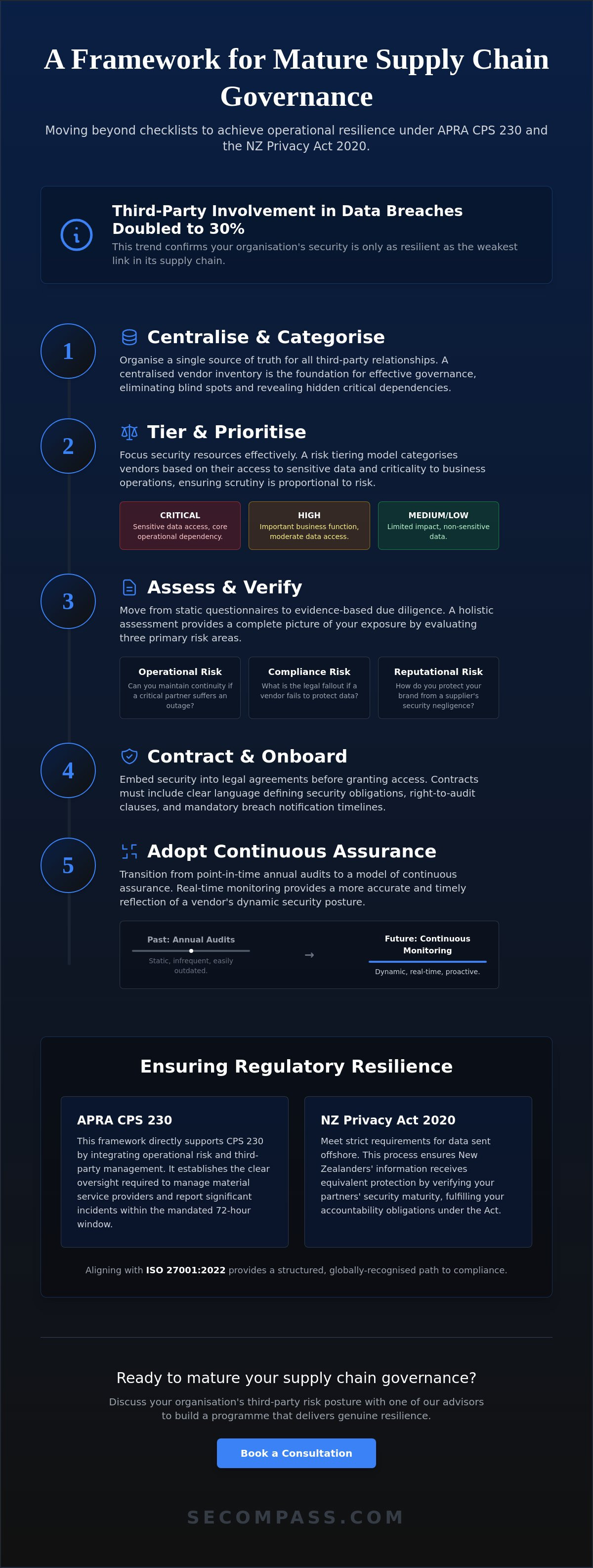
A 5-Step Framework to Organise Supply Chain Governance
Building a resilient supply chain requires a transition from reactive troubleshooting to a repeatable, governance-led process. This framework allows leadership to maintain oversight without becoming entangled in the administrative burden of manual vendor management. By following these five steps, you can ensure that your security investments are directed where they provide the most significant risk reduction.
- Step 1: Define Risk Appetite. Formalise a TPRM policy that aligns with your board's tolerance for operational and privacy disruptions.
- Step 2: Tier Vendors. Categorise suppliers based on their access to sensitive data and their criticality to your daily operations.
- Step 3: Conduct Tailored Assessments. Use a modular third party risk assessment questionnaire that scales in complexity based on the vendor’s assigned risk tier.
- Step 4: Formalise Remediation. Work with vendor owners to accept identified risks or implement clear remediation plans with firm, documented deadlines.
- Step 5: Report to the Board. Establish a continuous reporting cadence that provides directors with a clear view of supply chain maturity and residual risk.
Deep Dive: How to Tier Your Vendors Effectively
Effective tiering is the engine of a scalable TPRM programme. Critical vendors are those whose failure would stop your business from functioning, while high-risk vendors are those with access to protected customer data. The depth of a security assessment is directly proportional to the sensitivity of the data a vendor handles and the impact of their service failing. Using this tiering logic allows your team to focus their analytical efforts on the 20% of vendors that represent 80% of your risk, saving hundreds of hours otherwise spent on manual reviews of non-essential suppliers.
The Art of Remediation and Collaborative Security
When a vendor fails to meet your standards, the goal is not necessarily to terminate the relationship immediately. Instead, act as a strategic mentor by documenting compensating controls or partnering with the vendor to improve their security posture over time. The expert analysis of a third party risk assessment questionnaire requires professional judgement to distinguish between a vendor’s stated policy and their actual operational reality. If you are looking to elevate your governance maturity, our Third-Party Risk Management (TPRM) advisory services can guide your leadership team through this complex transition.
The vCISO Advantage: Elevating Your Supply Chain Resilience
Managing supply chain risk is not merely a technical hurdle; it's a strategic necessity that requires executive-level oversight. Integrating Third-Party Risk Management into a broader vCISO and Privacy strategy allows your organisation to move beyond simple compliance. You begin to build a trust-based supply chain where security is a shared value rather than a contractual obligation. For many firms in Melbourne and Auckland, SeComPass serves as this stabilising force, providing the expertise needed to scale a risk function without the overhead of a full-time executive.
This leadership model ensures that TPRM is not an isolated silo. Instead, it becomes a milestone in your broader business evolution, aligning vendor oversight with your operational resilience goals. By leveraging a vCISO, you gain access to a professional who has navigated these regulatory waters many times, ensuring your framework remains robust as the Australian and New Zealand landscapes continue to shift.
Software vs Strategic Advisory: Choosing Your Path
While TPRM platforms offer efficient data collection, they often fall short when interpreting the "grey areas" of a third party risk assessment questionnaire. A software rating might indicate a passing grade, but it cannot assess the underlying governance culture or the maturity of a vendor's internal processes. This is where expert-led reviews provide genuine value. Our vCISO services New Zealand and Australia teams bridge the gap between raw data and actionable business intelligence, ensuring your leadership team makes decisions based on context rather than just scores.
Starting Your TPRM Journey with SeComPass
Securing your supply chain begins with three foundational actions. First, conduct a quick gap analysis of your current vendor oversight to identify immediate exposures and undocumented critical dependencies. Second, formalise your risk appetite to ensure your team is not over-investing in low-risk assessments. Third, refine your third party risk assessment questionnaire to focus on the specific evidence-based requirements of your industry regulators. If you're ready to advance your cybersecurity maturity, we invite you to organise a consultation with our Melbourne or Auckland teams to discuss your strategic roadmap.
Strengthening Your Operational Resilience Through Strategic Oversight
Managing supply chain integrity is a journey of continuous improvement rather than a one-off compliance task. By shifting from static, point-in-time audits to a model of continuous assurance, your organisation can better navigate the complexities of the modern regulatory landscape. We've explored how a robust third party risk assessment questionnaire serves as a foundational tool, yet its true value is unlocked through expert analysis that identifies hidden vulnerabilities within your vendor ecosystem.
With offices in Melbourne and Auckland, SeComPass provides on-the-ground support to help you implement frameworks like ISO 27001, SOC 2, and NIST. Our partnership-oriented approach ensures that your security and privacy requirements are met with practical, high-level executive advisory. You don't have to manage these evolving risks alone. We invite you to secure your supply chain with a strategic vCISO partnership that prioritises long-term stability and maturity. Building a resilient organisation is a collaborative effort, and we're here to lead the way.
Frequently Asked Questions
How often should I reassess my third-party vendors?
Reassessment frequency is determined by the vendor's risk tier rather than a generic schedule. Critical partners usually require continuous monitoring or a deep review every twelve months, while low-risk suppliers might only be reassessed every two years or when their service scope changes. This risk-based approach ensures your team doesn't waste resources on low-impact relationships while maintaining a steady pulse on your most vital dependencies.
Can I outsource the entire third-party risk management process?
You can outsource the operational execution of your programme, but the ultimate accountability for risk stays with your leadership team. Engaging a strategic advisor to manage your TPRM function allows you to access specialised expertise without the cost of a full-time executive. This model provides the necessary oversight and evidence-based reporting required by Australian regulators while allowing your internal staff to focus on core business objectives.
What are the most common third-party risks for Australian businesses?
Data breaches and operational disruptions are currently the most prevalent threats to Australian supply chains. According to the Verizon 2025 Data Breach Investigations Report, third-party involvement in breaches has doubled to 30%. Beyond cyber incidents, Australian firms face significant regulatory risk under APRA CPS 230, which requires strict management of fourth-party subcontractors who may be invisible to your primary security controls.
Is a SOC 2 report enough to satisfy third-party risk requirements?
A SOC 2 report is an excellent baseline for assurance, but it rarely covers every specific requirement of a comprehensive third party risk assessment questionnaire. While a SOC 2 provides a snapshot of a vendor's controls, it doesn't necessarily align with your unique risk appetite or local compliance needs like the NZ Privacy Act 2020. You should treat these reports as supporting evidence rather than a complete substitute for your own due diligence.
How do I manage risk if a vendor refuses to fill out a questionnaire?
If a vendor refuses to complete a third party risk assessment questionnaire, you should request alternative evidence such as a current ISO 27001 certification or a SOC 2 Type 2 report. If no independent assurance is available, you must decide if the operational value of the vendor outweighs the lack of visibility. In these cases, leadership should formalise a risk acceptance memo or implement stronger internal compensating controls to mitigate the exposure.
Does the NZ Privacy Act 2020 apply to vendors based in the US or Europe?
Yes, the NZ Privacy Act 2020 applies to any offshore vendor that processes personal information on behalf of a New Zealand organisation. Under Principle 12, you must ensure the foreign provider is subject to comparable safeguards to those found in New Zealand law. This often requires specific contractual clauses or a Privacy Impact Assessment to verify the vendor's ability to protect the data of New Zealand citizens.