
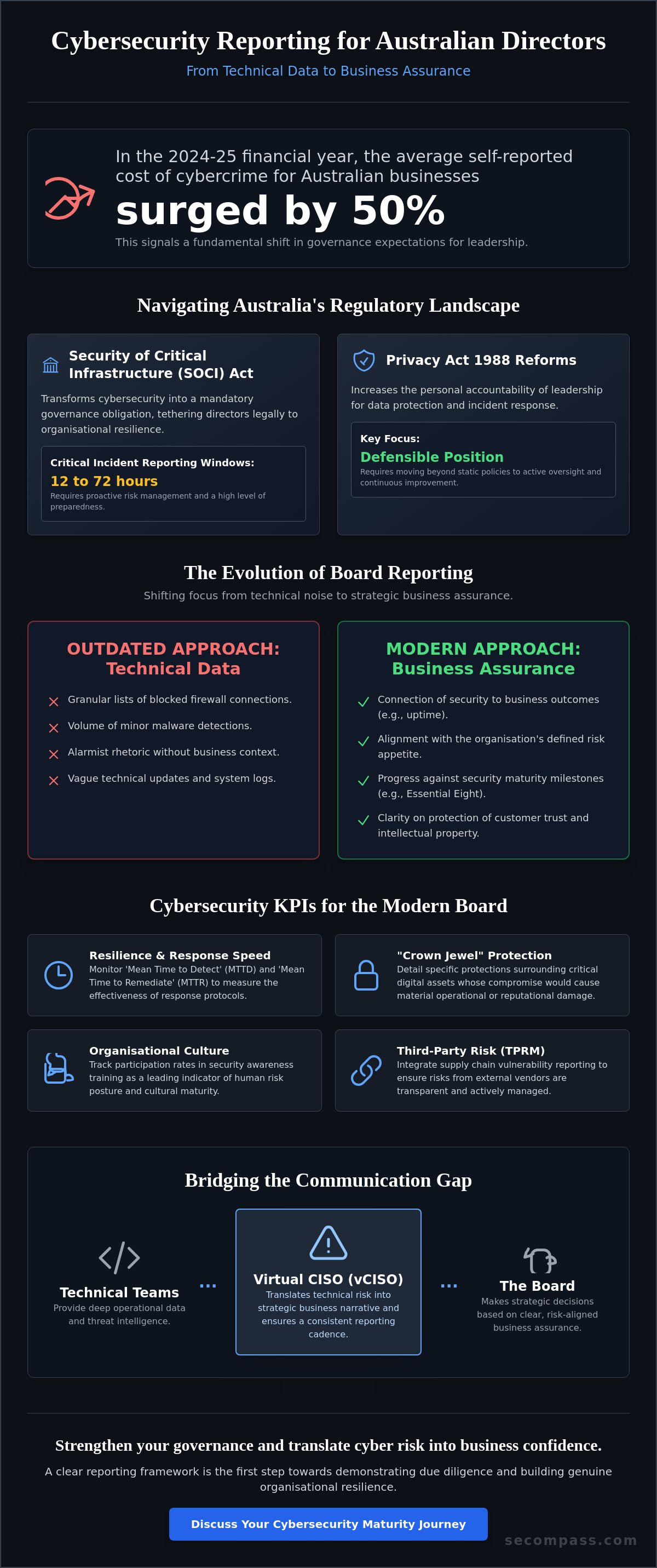
In the 2024-25 financial year, the average self-reported cost of cybercrime for Australian businesses surged by 50 per cent, with medium-sized organisations experiencing the fastest growth in losses. For a director, these figures represent more than just a budgetary concern. They signal a fundamental shift in the expectations placed on leadership. You likely recognise that while the volume of data provided by technical teams has increased, the actual sense of security at the board table often remains elusive. Effective cybersecurity board reporting is no longer about reviewing a list of blocked threats, but about understanding how those threats impact your strategic objectives and legal obligations.
It's understandable to feel a sense of unease regarding personal liability, especially with the 2025 ransomware reporting rules and the SOCI Act requiring such rapid response times. This article provides a framework to move beyond information overload and master the art of translating technical risk into business assurance. We will examine how to establish a reporting cadence that builds genuine confidence, aligns security spend with your specific risk appetite, and ensures your organisation remains compliant with the evolving Privacy Act oversight requirements.
Key Takeaways
- Understand how the SOCI Act has transformed cybersecurity from a technical concern into a mandatory governance obligation for Australian directors.
- Refine your cybersecurity board reporting by shifting from technical data dumps to strategic narratives that focus on risk appetite and business resilience.
- Identify the specific metrics that matter to the boardroom, prioritising operational uptime and customer trust over alarmist technical rhetoric.
- Discover how a Virtual CISO (vCISO) can bridge the communication gap between technical teams and the board to ensure a consistent reporting cadence.
- Recognise the importance of tracking security maturity milestones as a means of demonstrating long-term progress and regulatory compliance.
The Evolution of Boardroom Accountability in the Australian Landscape
Cybersecurity has transitioned from a technical support function to a non-negotiable pillar of corporate governance. Driven largely by the Security of Critical Infrastructure (SOCI) Act 2018 and subsequent amendments, directors are now legally tethered to the resilience of their organisations. Passive reception of technical data is no longer a defensible stance. The 2026 landscape requires active oversight of cyber maturity and a clearly defined risk appetite. With the Australian Cyber Security Centre (ACSC) receiving a report every six minutes, the pace of the threat environment is relentless. Effective cybersecurity board reporting serves as a stabilising force, offering the board and shareholders reassurance that the enterprise can maintain operational integrity during systemic shocks.
Navigating the Australian Regulatory Handshake
The legislative environment has matured rapidly. Reforms to the Privacy Act 1988 have increased the personal accountability of leadership teams for data protection and incident response. This shift aligns with broader trends in global cybersecurity regulation, where transparency and accountability are the new standard. To build a defensible position, directors must move beyond "set and forget" policies. They must instead demand a narrative that links security investment directly to the protection of critical business assets.
The 2026 regulatory environment in Australia demands evidence of continuous improvement rather than static compliance. Under the SOCI Act, responsible entities must report incidents within 72 hours, or in some cases, 12 hours. Meeting these windows requires a level of preparedness that can only be achieved through proactive risk management. Standardising reports around the Essential Eight maturity model provides a clear, objective metric for progress. When paired with international standards like ISO 27001, these frameworks move the conversation away from vague technical updates and toward verifiable business assurance. This structured approach helps directors discharge their duties with confidence. For many Australian organisations, achieving this level of oversight involves engaging a Virtual CISO to bridge the gap between technical operations and executive strategy.
Translating Technical Metrics into Strategic Business Assurance
Boards do not require a granular list of blocked firewall connections or minor malware detections. They require a narrative that connects security activities to tangible business outcomes, such as operational uptime, customer trust, and the protection of intellectual property. Effective cybersecurity board reporting relies on moving away from alarmist rhetoric. Instead, it should focus on the steady progress of security programmes and the achievement of maturity milestones. By presenting information in a modular format, leadership can clearly distinguish between current risks, the mitigations in place, and the residual exposure that remains within the organisation's risk appetite.
Defining Material Risk and Risk Appetite
A primary challenge in the boardroom is the lack of a shared vocabulary. Directors and technical teams must align on what constitutes a material cyber incident. This involves identifying the "Crown Jewels" of the organisation. These are the critical digital assets that, if compromised, would result in significant operational or reputational damage. Reporting should specifically detail the protections surrounding these assets. Additionally, as supply chain vulnerabilities increase, integrating Third-Party Risk Management (TPRM) into the board report ensures that the risks posed by external vendors are transparent and managed. If you are currently refining these definitions, you may wish to discuss your cybersecurity maturity journey with a strategic advisor.
Cybersecurity KPIs for the Modern Board
To track the trajectory of a security posture, metrics must remain consistent over time. Modern boards are shifting their focus toward leading indicators. Rather than simply counting historical incidents, directors should monitor the "mean time to detect" and "mean time to remediate." These metrics provide a clearer picture of organisational resilience and the effectiveness of response protocols. Furthermore, reporting on participation rates in security awareness training offers a valuable metric for organisational culture and human risk. For a deeper dive into specific measurements, explore these cybersecurity KPIs every Australian board should track. This data driven approach allows the board to justify security spend by demonstrating a direct correlation between investment and risk reduction.
Establishing a Sustainable Reporting Cadence with Virtual Leadership
A robust framework for cybersecurity board reporting is only as effective as the leadership driving its execution. Many Australian mid-market organisations find themselves in a challenging position: they recognise the need for strategic oversight but lack the requirement for a full-time, resident executive. Bridging the gap between complex technical operations and high-level business strategy requires a dedicated leader who can translate risk into assurance. Without this bridge, reporting often becomes a reactive exercise, triggered by incidents rather than guided by a disciplined, proactive cadence that supports long-term stability.
The Role of the vCISO in Board Governance
Engaging a Virtual CISO (vCISO) allows an organisation to access executive-level expertise without the overhead of a permanent hire. This role provides the professional composure and strategic perspective necessary for effective board briefings. A vCISO acts as a mentor to the board, guiding directors through multifaceted decisions regarding risk appetite and security investment. For entities with specific government or defence obligations, a Virtual ISM can ensure that all reporting remains strictly aligned with the Australian Government Information Security Manual. This independent advisory model provides an objective view of security maturity, free from the internal biases that can sometimes colour technical reports.
Next Steps for Enhancing Board Oversight
Improving your reporting structure begins with a thorough gap analysis to identify where communication between technical teams and the board is failing. From there, you can establish a formalised reporting template that satisfies internal governance requirements and prepares the organisation for external audits. As you evaluate your security investment, you might consider the cost of ISO 27001 certification as a benchmark for maturity. Moving toward a standardised framework ensures that security is viewed as a business enabler that supports growth and operational resilience. We invite you to speak with our experts to discuss your cybersecurity maturity journey and how a structured reporting cadence can protect your organisation's future.
Strengthening Your Strategic Governance Posture
The landscape for Australian directors is no longer one of passive observation. By aligning your reporting with maturity frameworks and focusing on material business risks, you transform security from a technical requirement into a pillar of operational resilience. Effective cybersecurity board reporting provides the clarity needed to satisfy both regulatory mandates and stakeholder expectations.
At SeComPass, we bring decades of executive-level leadership to the table. Our teams in Melbourne and Auckland offer localised support across Australia and New Zealand, providing expert advisory for ISO 27001, SOC 2, and NIST frameworks. We help you navigate these complexities with the composure and precision your boardroom requires. If you are ready to move beyond technical metrics and embrace a more mature oversight model, we invite you to discuss your cybersecurity maturity journey with our experts. Building a defensible and resilient organisation is a continuous process, and we are here to guide you through every milestone.
Frequently Asked Questions
What are the top three cybersecurity questions a board should ask?
Directors should focus on questions that bridge the gap between technical activity and business resilience. Firstly, ask how the organisation's current security posture aligns with its defined risk appetite. Secondly, enquire about the specific protections in place for "Crown Jewel" assets, which are the digital components most critical to your operations. Finally, ask for evidence of how security investments are measurably improving maturity scores against frameworks like the Essential Eight or ISO 27001.
How often should cybersecurity be on the board agenda in Australia?
Cybersecurity should be a standing item on every quarterly board agenda at a minimum. However, for organisations governed by the SOCI Act or those in high risk sectors, monthly briefings are becoming the standard. Regular cybersecurity board reporting ensures that leadership remains informed about the evolving threat landscape and can make timely decisions regarding resource allocation and risk mitigation.
Should the board be involved in technical details of a cyber attack?
The board's role is to provide strategic oversight and governance, not to manage technical troubleshooting. During an incident, directors should focus on the material impact on business operations, the protection of customer data, and the organisation's legal obligations under the Privacy Act. Leave the technical mechanics of the breach to the operational teams while you prioritise leadership accountability and stakeholder communication.
What is the difference between a technical dashboard and a board report?
A technical dashboard is designed for operational teams to track granular metrics, such as patch rates or firewall blocks, in real time. In contrast, a board report provides a strategic narrative that translates these metrics into business assurance. It focuses on outcomes, such as operational uptime and reputational integrity, providing the board with a clear understanding of how security initiatives support the broader corporate strategy.

Article by
Jatinder Oberoi
Founder and Principal Consultant at SeComPass, a cybersecurity, privacy, governance, and compliance advisory firm supporting organisations across Australia and New Zealand. With extensive experience in cybersecurity leadership, risk management, ISO 27001, SOC 2, privacy, and governance advisory, he works closely with executive teams to help organisations strengthen operational resilience and improve cybersecurity maturity. Known for his pragmatic and business-focused approach, Jatinder specialises in translating complex cybersecurity and compliance challenges into clear, actionable strategies for leadership teams. His work focuses on helping organisations align security initiatives with business objectives, governance expectations, regulatory obligations, and long-term resilience outcomes. Through SeComPass, he regularly advises organisations on cybersecurity governance, AI risk, third-party risk, compliance frameworks, security leadership, and enterprise resilience. His writing and advisory approach emphasises clarity, practical decision-making, and sustainable security maturity over fear-driven cybersecurity messaging.