
If your board still views cybersecurity as a technical line item rather than a core governance responsibility, your organisation is operating on an outdated map. The release of NIST CSF 2.0 in early 2024 marked a fundamental shift in how we approach risk, moving beyond technical controls to place governance at the very heart of the framework. Many Australian leaders now face the pressure of demonstrating maturity as national spending on information security is projected to exceed AU$7.5 billion in 2026. It's an environment where compliance fatigue is common, especially when you're tasked with translating technical vulnerabilities into the language of business risk.
We recognise the challenge of aligning international standards with local requirements like the Essential Eight. This guide explains how NIST CSF 2.0 integrates governance into your security strategy to drive maturity and operational resilience. We'll examine the updated framework lifecycle and provide a structured way to communicate security value to your board. By the end of this briefing, you'll have a clear path to align global benchmarks with your specific business objectives, turning cybersecurity from a cost centre into a pillar of strategic trust.
Key Takeaways
- Understand why NIST CSF 2.0 has evolved from a technical framework into a comprehensive governance mandate for organisations of all sizes.
- Learn how the new "Govern" function bridges the gap between technical security teams and board-level risk oversight.
- Discover how to use the six core functions as a continuous lifecycle to build long-term operational resilience.
- Identify the practical steps for establishing a maturity roadmap, starting with a gap analysis and a custom Target Profile.
- Gain clarity on aligning global cybersecurity standards with local Australian expectations and business objectives.
The Evolution of Cybersecurity Governance: Understanding NIST CSF 2.0
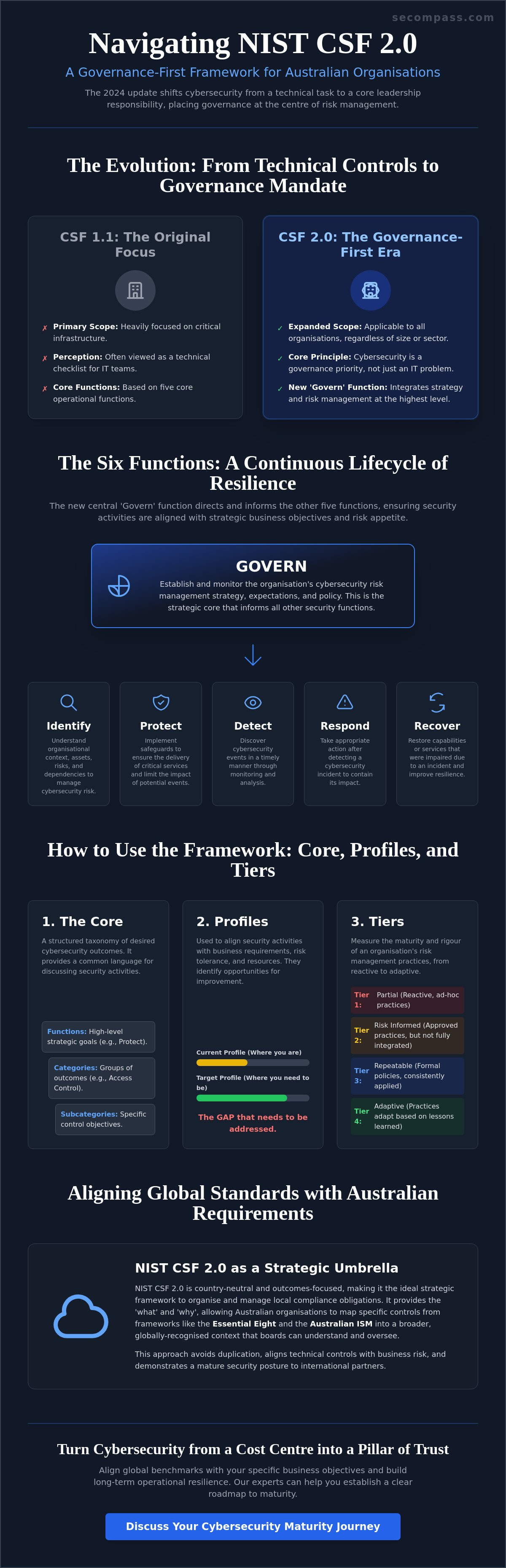
NIST CSF 2.0 is a neutral, outcomes-based framework designed to help organisations manage and reduce cybersecurity risk through a common language. While the original version focused heavily on critical infrastructure, the 2.0 update released in February 2024 expanded its scope to include all organisations, regardless of their size, sector, or maturity level. This shift acknowledges that every enterprise is now part of a global, interconnected supply chain where a single vulnerability can have cascading effects.
The transition from version 1.1 to NIST CSF 2.0 reflects a broader evolution in modern enterprise expectations. we've moved away from viewing cybersecurity as a purely technical challenge managed by the IT department; it is now a governance-first priority. For many Australian boards, this framework provides the necessary vocabulary to discuss risk with their virtual CISO, ensuring that security investments are directly linked to business outcomes. By adopting the NIST Cybersecurity Framework, leaders can move beyond reactive checklists and toward a strategic, long-term posture of assurance.
The Govern Function: Why Leadership is Now at the Centre
The addition of "Govern" as the sixth core function is the most significant change in the framework. This pillar focuses on how an organisation's cybersecurity strategy, policies, and roles are established and monitored. It does not sit in isolation; it informs and directs the other five functions to ensure security activities align with business objectives. In the Australian context, this alignment is vital for addressing director liability and corporate oversight. Effective governance ensures that security activities are not just technical exercises but are prioritised based on the organisation’s specific risk appetite and mission.
Framework Components: Core, Profiles, and Tiers
Understanding the framework requires a grasp of its three primary components. The Core provides a structured taxonomy of desired security outcomes, organised into functions, categories, and subcategories. Organisational Profiles allow a business to describe its current security state and its desired "Target Profile," highlighting gaps that need investment. Finally, Tiers offer a way to measure the rigour of risk management practices, moving from "Partial" to "Adaptive" as the organisation’s maturity grows. This modular structure allows leadership to customise the framework to their unique operational needs.
The Six Functions: A Strategic Framework for Australian Resilience
The six functions of NIST CSF 2.0 (Govern, Identify, Protect, Detect, Respond, and Recover) form a continuous lifecycle. Rather than a static checklist, these functions represent an ongoing commitment to stewardship; they ensure that security is a living part of the business. This structured approach provides a vital bridge between technical teams and executive leadership. It allows a CISO to explain technical gaps in terms of business impact, ensuring the board understands how each investment supports operational continuity. For mid-market firms, the focus on "Respond" and "Recover" is particularly critical. True resilience is measured by the speed of recovery, not just the strength of the perimeter; this is why many organisations look to specialist providers like CyberOne for advanced detection and response capabilities.
Because the framework is country-neutral, it integrates seamlessly with local requirements like the Australian ISM. This adaptability ensures that Australian leaders can maintain global compliance standards while still satisfying domestic regulatory expectations. This alignment helps organisations build a posture that is both locally compliant and globally recognised. If you are looking to refine this alignment within your own organisation, you might schedule a security assessment to evaluate your current maturity level.
Mapping NIST 2.0 to Local Australian Standards
NIST CSF 2.0 acts as a strategic umbrella framework. It organises specific, granular controls found in the Essential Eight into a broader context that executives can manage. For businesses with international partners, using a global standard provides a competitive advantage; it demonstrates a level of maturity that is understood worldwide. To avoid duplication of effort and wasted resources, leaders should consider a strategic comparison between standards. This ensures that every control implemented serves multiple compliance and risk goals simultaneously.
Prioritising Outcomes over Implementation
A key strength of the framework is its focus on outcomes rather than specific implementation steps. It defines "what" a secure organisation looks like, not the exact brand of software you must buy. This flexibility is vital for cost-effective risk management. By leveraging NIST Cybersecurity Framework resources, organisations can select controls that offer the highest risk reduction for their specific budget and risk profile. It allows leadership to focus on achieving systemic integrity rather than just following a rigid technical manual.
Implementing NIST CSF 2.0: A Roadmap to Maturity
The successful implementation of NIST CSF 2.0 begins with an honest assessment of your current state. Conducting a thorough gap analysis against the CSF Core allows leadership to identify where existing controls meet expectations and where vulnerabilities remain. This data serves as the foundation for a "Target Profile," which is a tailored vision of security that reflects your organisation’s specific mission and risk appetite. Rather than chasing every possible control, a Target Profile ensures that your resources are directed toward the risks that matter most to your business continuity.
Moving from your current state to the target level requires a prioritised action plan. This is not a one-off project; it is an iterative process of refinement and stewardship. As the threat landscape evolves, your roadmap must adapt to maintain the desired level of maturity. By focusing on steady progress rather than quick fixes, you build a culture of resilience that can withstand the complexities of the modern operating environment.
The Role of Advisory in Navigating Framework Complexity
Engaging a virtual CISO provides the senior leadership necessary to drive this implementation without the overhead of a full-time executive. An advisor brings independent assurance, which is vital for maintaining board trust during complex transitions. Achieving NIST CSF 2.0 readiness also streamlines the path toward other international standards. The groundwork laid during this process significantly reduces the effort required to prepare for more prescriptive certifications, such as ISO 27001.
Measuring and Reporting Progress to the Board
The NIST Tiers offer a sophisticated yet accessible way to report cybersecurity maturity to non-technical directors. Instead of technical jargon, Tiers describe the rigour of risk management practices, ranging from "Partial" to "Adaptive." Meaningful key performance indicators (KPIs) should be derived from the Govern and Identify functions, focusing on metrics like the percentage of critical assets covered by the current profile. It is also essential to integrate third-party risk management into this lifecycle. Ensuring that your partners meet similar maturity standards is no longer optional; it is a core requirement for systemic resilience.
Strengthening Your Strategic Security Posture
Adopting NIST CSF 2.0 is more than a compliance exercise; it's a commitment to long-term operational resilience and board-level accountability. By integrating the "Govern" function into your core strategy, you move from reactive technical fixes to a proactive stance that enables business growth. We've explored how the six functions provide a common language for leadership and how a tailored Target Profile ensures your security investments are always purposeful. This strategic alignment turns cybersecurity from a technical necessity into a fundamental pillar of organisational trust.
Our team provides senior-level advisory focused on business enablement, helping you navigate the complexities of ISO 27001, SOC 2, and NIST with confidence. With offices in Melbourne and Auckland, we offer local expertise grounded in the specific regulatory expectations of the Australian and New Zealand environments. Whether you are just beginning your gap analysis or refining an established roadmap, we are here to support your progress with steady, practical guidance.
Discuss your cybersecurity maturity journey with our experts to ensure your organisation is prepared for the challenges of 2026 and beyond. Building a mature security posture is a steady journey, and we look forward to walking that path with you.
Frequently Asked Questions
Is NIST CSF 2.0 mandatory for Australian companies?
No, NIST CSF 2.0 is not a mandatory legal requirement for Australian businesses. It remains a voluntary framework that provides an internationally recognised benchmark for managing risk. However, it is highly recommended as a tool to demonstrate maturity and alignment with domestic expectations, such as the SOCI Act and the Australian Cyber Security Centre’s advice. Adopting the framework helps organisations provide assurance to partners and regulators that their security posture is managed with professional rigour.
What is the biggest difference between NIST CSF 1.1 and 2.0?
The most significant change is the addition of the "Govern" function, which elevates cybersecurity from a technical department task to a core leadership responsibility. Version 2.0 also officially expands its scope beyond critical infrastructure to include all organisations, regardless of their size or sector. This shift ensures that NIST CSF 2.0 is now a universal tool for any enterprise looking to integrate security into its broader corporate governance and risk management strategy.
How does NIST CSF 2.0 relate to the Essential Eight?
NIST serves as a strategic "umbrella" framework, while the Essential Eight provides a set of specific, technical baseline controls. The Essential Eight focuses on mitigating the most common cyber threats through technical implementation; conversely, NIST provides the high-level governance and risk management structure that oversees those controls. Using them together allows Australian leaders to ensure their technical defences are not just implemented, but are also aligned with the organisation’s overall mission and risk appetite.
Can a small business use NIST CSF 2.0 or is it only for large enterprises?
The framework is designed to be scalable and is highly effective for organisations of all sizes. NIST has specifically released a Small Business Quick Start Guide for version 2.0 to make the framework more accessible for smaller teams with limited resources. Because it is outcomes-based, a small business can focus on the most critical risks first. This provides a clear, manageable path to maturity without requiring the massive overhead often associated with larger global enterprise standards.

Article by
Jatinder Oberoi
Founder and Principal Consultant at SeComPass, a cybersecurity, privacy, governance, and compliance advisory firm supporting organisations across Australia and New Zealand. With extensive experience in cybersecurity leadership, risk management, ISO 27001, SOC 2, privacy, and governance advisory, he works closely with executive teams to help organisations strengthen operational resilience and improve cybersecurity maturity. Known for his pragmatic and business-focused approach, Jatinder specialises in translating complex cybersecurity and compliance challenges into clear, actionable strategies for leadership teams. His work focuses on helping organisations align security initiatives with business objectives, governance expectations, regulatory obligations, and long-term resilience outcomes. Through SeComPass, he regularly advises organisations on cybersecurity governance, AI risk, third-party risk, compliance frameworks, security leadership, and enterprise resilience. His writing and advisory approach emphasises clarity, practical decision-making, and sustainable security maturity over fear-driven cybersecurity messaging.