SOC 2 vs ISO 27001: A Strategic Comparison for Australian Business Leaders
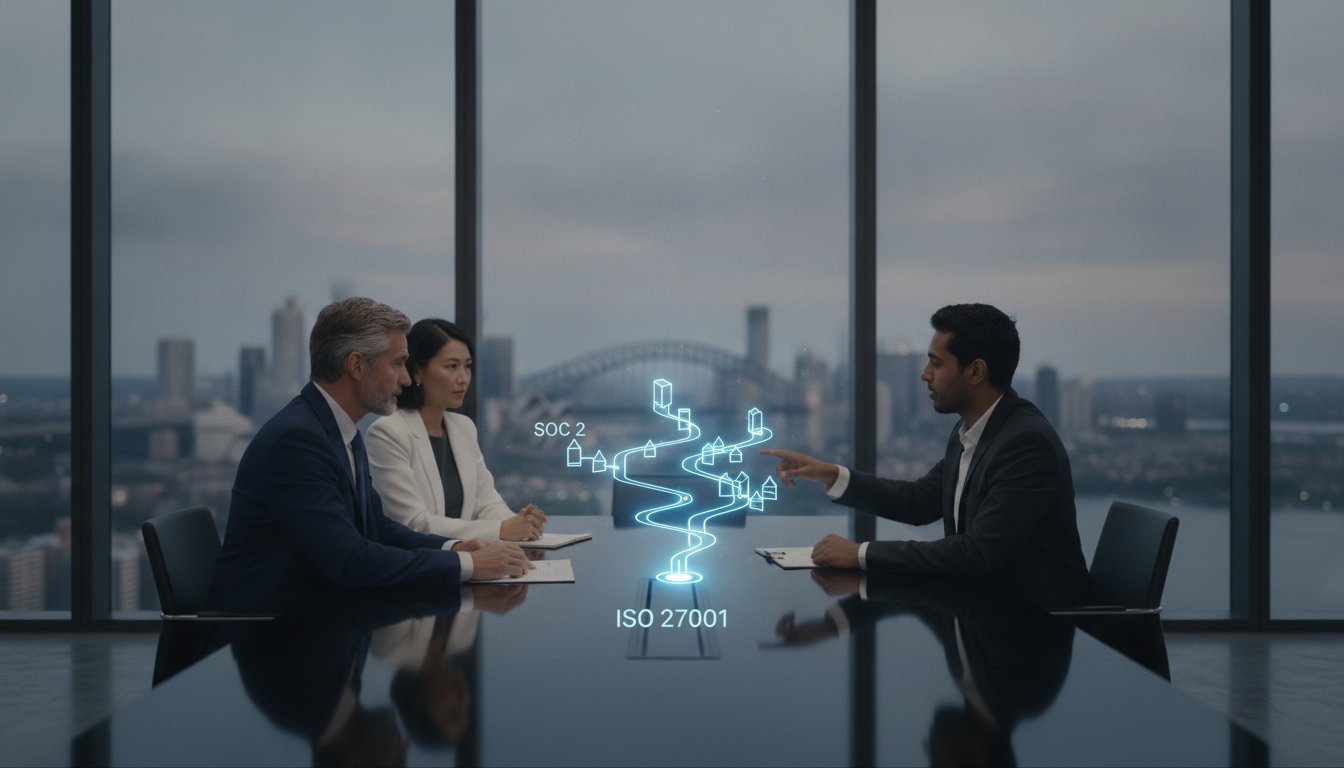
An Australian technology firm recently reached a definitive milestone: a verbal agreement with a major North American enterprise. The momentum stalled during the final security review when the client requested a SOC 2 report, even though the firm had already invested in ISO 27001. This scenario highlights a common tension for leaders navigating global expansion. Deciding between SOC 2 vs ISO 27001 is not merely a technical choice. It is a strategic decision that impacts market access and organisational maturity.
It's understandable to feel concerned about the potential for redundant effort or the risk of misallocating resources. This briefing provides a clear decision-making framework to ensure your security investments align with your long-term growth objectives. We will examine how to leverage your current governance efforts to satisfy multiple standards, providing a roadmap that meets Australian board expectations while building enterprise trust on the global stage.
Key Takeaways
- Understand the fundamental distinction between ISO 27001 as a comprehensive governance framework and SOC 2 as a reporting standard for service delivery.
- Identify which security path best facilitates your international expansion, particularly when navigating the specific demands of the North American market.
- Evaluate the strategic trade-offs in a SOC 2 vs ISO 27001 comparison to determine which provides the most value for your current organisational maturity.
- Discover how to leverage the substantial overlap between these frameworks to streamline compliance and reduce the operational burden on your internal teams.
- Learn to align your chosen security standard with Australian board expectations and the evolving regulatory requirements of the Privacy Act.
The Strategic Context: Defining SOC 2 and ISO 27001 in 2026
The choice between SOC 2 vs ISO 27001 is rarely about which framework is "better," but rather which one aligns with your specific growth trajectory. ISO 27001 is the global standard for an Information Security Management System (ISMS), providing a comprehensive, risk-based approach to security governance. Conversely, SOC 2 is an auditing procedure developed by the American Institute of Certified Public Accountants (AICPA). It is designed specifically for service providers to report on the effectiveness of their internal controls. While both frameworks aim to cultivate trust with partners, they serve distinct strategic functions. An Information Security Management System serves as the structural foundation for organisational resilience, ensuring that security is integrated into every business process rather than existing as an isolated technical layer.
ISO 27001: The International Benchmark for Security Maturity
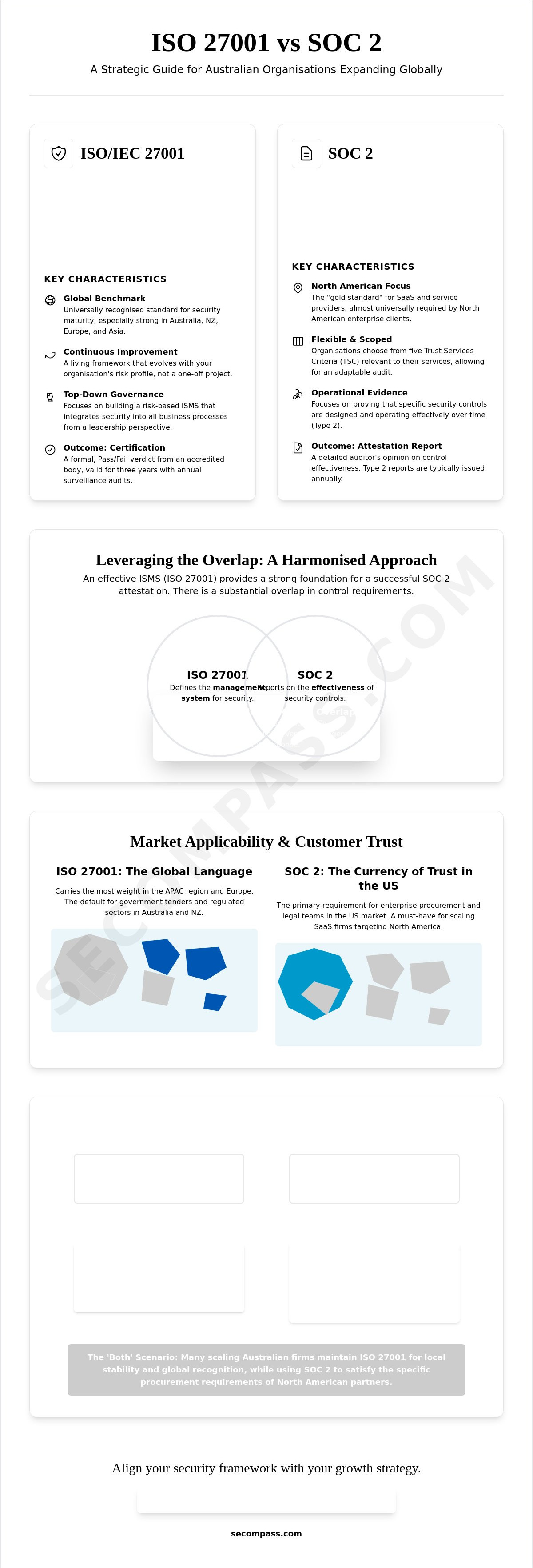
Adopting the ISO/IEC 27001 standard signals a commitment to a continuous improvement cycle. It is not a one-off project but a living framework that evolves with your risk profile. For Australian firms eyeing European or Asian markets, ISO 27001 provides a universally recognised language of security. It specifically addresses the governance expectations found in regulations like the EU's NIS2 Directive, making it a powerful tool for global market entry. For leaders who require strategic oversight of these frameworks, engaging a virtual Information Security Manager can provide the necessary guidance to maintain this maturity.
SOC 2: Demonstrating Operational Excellence to North American Partners
SOC 2 focuses on five Trust Services Criteria (TSC): Security, Availability, Confidentiality, Processing Integrity, and Privacy. Unlike the broader governance focus of ISO, SOC 2 provides a granular look at how controls operate in practice. North American enterprise clients almost universally require a SOC 2 Type 2 report, as it offers a detailed opinion on control effectiveness over a specific period. This attestation is often the "gold standard" for SaaS providers seeking to build credibility with US-based procurement and legal teams. It demonstrates that your organisation does not just claim to be secure, but has the audit evidence to prove it.
Structural Comparisons: Scope, Flexibility, and Market Expectations
The architecture of these frameworks reflects their underlying philosophies. ISO 27001 follows a rigid, prescriptive structure that ensures every certified organisation meets a specific baseline of maturity. This makes it the international standard for information security. Conversely, SOC 2 offers greater flexibility. It allows firms to choose which Trust Services Criteria are relevant to their specific service delivery. While this adaptability is useful, it can lead to audit inconsistencies if the scope is not defined with strategic precision.
A fundamental distinction lies in the outcome of the assessment. ISO 27001 results in a formal certification, which is a pass or fail verdict from an accredited body. SOC 2 produces a detailed attestation report. This document provides an auditor’s opinion on the effectiveness of controls over a specific period. For Australian businesses, target markets often dictate the priority. ISO 27001 remains the default expectation for Australian and New Zealand government tenders and highly regulated domestic sectors.
Market Applicability and Customer Trust
The geographic focus of your expansion strategy should guide your decision in the SOC 2 vs ISO 27001 debate. In the APAC region and Europe, ISO 27001 carries the most weight. It is viewed as a comprehensive signifier of governance maturity. In the US market, however, SOC 2 is the primary currency of trust. Many scaling Australian SaaS firms eventually find themselves in a "both" scenario. They maintain ISO 27001 for local stability and global recognition, while using SOC 2 to satisfy the specific procurement requirements of North American enterprise partners.
The Audit Process and Ongoing Maintenance
Maintenance cycles also differ significantly. ISO 27001 operates on a three year certification cycle, involving annual surveillance audits to ensure the management system remains effective. SOC 2 reports are typically issued annually, particularly for Type 2 reports that cover a six to twelve month window. Both require a significant investment of time and resources. When evaluating the cost of ISO 27001 certification or SOC 2 reporting, leaders should consider the long-term operational overhead. To ensure your choice aligns with your commercial goals, you may wish to discuss your cybersecurity maturity journey with a strategic advisor.
The Integrated Path: Strategic Implementation for Australian Firms
Successful organisations don't view security frameworks as a series of isolated technical hurdles. Instead, they integrate these standards into the very fabric of their business operations. When evaluating the path of SOC 2 vs ISO 27001, it is helpful to recognise that these frameworks share a significant overlap, often exceeding 80% of the required controls. By mapping these shared requirements early in the process, you can streamline your implementation efforts and avoid the operational fatigue that comes with duplicative audits.
For Australian firms, this integration must also account for local governance expectations. Aligning your chosen framework with the ASD Essential Eight ensures that you meet domestic regulatory baselines while simultaneously pursuing international recognition. This holistic approach positions cybersecurity as a board-level responsibility. It shifts the focus from mere technical compliance to leadership accountability and strategic oversight, ensuring that security investments directly support organisational resilience.
Achieving Efficiency Through Framework Mapping
Mapping a single set of controls to multiple regulatory requirements significantly reduces the administrative burden on your internal teams. This unified approach ensures that evidence collected for one standard can be reused for another, creating a more efficient and repeatable process. Initiating an ISO 27001 readiness assessment is often the most effective first step in this journey. It establishes a robust governance foundation that simplifies the subsequent addition of SOC 2 or other regional requirements as your market reach expands.
The Role of Strategic Leadership in Certification Success
Executive sponsorship remains the primary predictor of success in any certification or attestation process. When the board and C-suite view security as a strategic enabler rather than a cost centre, the organisation is better equipped to sustain compliance over the long term. Many firms find that engaging a Virtual CISO provides the necessary strategic expertise to navigate these complex frameworks. This model offers the high-level guidance required to align your security roadmap with your commercial objectives, providing a scalable solution that grows alongside your business.
Enabling Sustainable Global Expansion
The choice between SOC 2 vs ISO 27001 represents a pivotal moment in an organisation's growth trajectory. By selecting the framework that mirrors your specific commercial expansion goals, you transform security from a technical requirement into a powerful market differentiator. Leaders should focus on building a management system that satisfies global partners while remaining firmly rooted in local governance expectations. This strategic alignment ensures that your security investments provide measurable value to the board and the broader business.
With a presence in Melbourne and Auckland, SeComPass provides the specialised vCISO leadership necessary to guide Australian enterprises through these complex decisions. Our expertise across ISO 27001, SOC 2, and NIST allows us to help you navigate the nuances of each standard with confidence. We invite you to discuss your cybersecurity maturity journey with our expert advisors. Establishing a clear roadmap today creates the stability and trust required to capture the opportunities of tomorrow.
Frequently Asked Questions
Is SOC 2 or ISO 27001 better for an Australian SaaS company?
The ideal framework depends primarily on your target market and expansion strategy. For an Australian SaaS company focused on domestic government tenders or European expansion, ISO 27001 is often the superior choice due to its global recognition and alignment with international regulations. If your primary growth objective is the North American market, SOC 2 becomes an essential requirement for enterprise procurement teams.
Can I use my ISO 27001 audit results to satisfy a SOC 2 requirement?
You cannot use an ISO 27001 certificate as a direct substitute for a SOC 2 report, but you can certainly leverage the existing work. Because the controls for SOC 2 vs ISO 27001 overlap by approximately 80%, the evidence and documentation prepared for your management system will satisfy the majority of SOC 2 requirements. This significantly reduces the time and cost associated with a dual audit process.
How does the Australian Essential Eight align with SOC 2 and ISO 27001?
The Essential Eight serves as a technical baseline that complements these broader governance frameworks. While the Essential Eight focuses on specific mitigation strategies for Australian organisations, these technical controls map directly into the technological themes of ISO 27001 and the security criteria of SOC 2. Achieving maturity in the Essential Eight provides a strong technical foundation for meeting international standards and satisfying local regulatory expectations.
What is the difference between a SOC 2 Type 1 and Type 2 report?
A SOC 2 Type 1 report assesses the design of your controls at a single point in time, essentially confirming that your security system is built correctly. A Type 2 report is more rigorous, evaluating the operational effectiveness of those controls over a period of six to twelve months. Most enterprise partners require a Type 2 report because it proves your security practices are consistent and reliable over time.

Article by
Jatinder Oberoi
Founder and Principal Consultant at SeComPass, a cybersecurity, privacy, governance, and compliance advisory firm supporting organisations across Australia and New Zealand. With extensive experience in cybersecurity leadership, risk management, ISO 27001, SOC 2, privacy, and governance advisory, he works closely with executive teams to help organisations strengthen operational resilience and improve cybersecurity maturity. Known for his pragmatic and business-focused approach, Jatinder specialises in translating complex cybersecurity and compliance challenges into clear, actionable strategies for leadership teams. His work focuses on helping organisations align security initiatives with business objectives, governance expectations, regulatory obligations, and long-term resilience outcomes. Through SeComPass, he regularly advises organisations on cybersecurity governance, AI risk, third-party risk, compliance frameworks, security leadership, and enterprise resilience. His writing and advisory approach emphasises clarity, practical decision-making, and sustainable security maturity over fear-driven cybersecurity messaging.