How Much Does ISO 27001 Certification Cost for Australian Businesses in 2026?

The most expensive element of your ISO 27001 journey is rarely the auditor's invoice, it's the hidden cost of a fragmented implementation strategy that quietly drains internal resources. Many Australian leadership teams find themselves caught between the necessity of robust information security and the ambiguity of the total cost of ISO 27001 certification. It is natural to feel a sense of hesitation when the line between external advisory fees and official audit requirements remains blurred, often leading to concerns about team burnout or unexpected budget overruns.
We recognise that a successful security posture requires more than just compliance, it requires a predictable investment strategy that aligns with your broader business goals. This guide provides a structured framework to help you navigate these financial commitments with clarity, ensuring your capital translates into genuine organisational resilience. We will examine the specific components of the 2026 pricing landscape, including implementation, internal audits, and annual surveillance, while outlining how to choose a path that supports long-term maturity and board-level confidence.
Key Takeaways
- View ISO 27001 as a multi-year strategic commitment to governance rather than a simple technical checklist to secure a single contract.
- Calculate the total cost of ISO 27001 certification by balancing external audit fees with the internal operational resources required for long-term maintenance.
- Navigate the four distinct phases of the certification journey, including the critical Stage 1 and Stage 2 audits conducted by accredited Australian bodies.
- Evaluate the vCISO model against traditional consultancy paths to determine which approach best supports your organisational maturity and resource allocation.
- Minimise the hidden internal resource tax by selecting an implementation strategy that prevents senior team burnout and maintains focus on revenue-generating activities.
Understanding the Investment: Why ISO 27001 Costs Vary for Australian Organisations
Imagine an Australian SaaS provider on the verge of securing a landmark contract with a Tier 1 bank. They have spent months in negotiations, yet the deal collapses at the final hurdle because they cannot provide independent assurance of their security governance. This scenario is increasingly common as enterprise procurement teams shift from a model of trust to one of verified compliance. The cost of ISO 27001 certification is best viewed not as a technical expense, but as a strategic investment in market access and organisational maturity.
Achieving compliance with the ISO/IEC 27001 standard is a multi-year commitment to a living management system, rather than a one-off technical audit. Your total investment is typically distributed across three primary pillars: preparation, which involves gap analysis and strategic planning; implementation, covering policy development and control remediation; and certification, which includes the formal audit fees. The initial financial outlay is largely dictated by the current maturity of your existing controls. If your organisation already operates with disciplined governance, the path to certification is often shorter and more cost-effective. Many firms engage a vCISO during the preparation phase to ensure their strategy is both lean and effective.
The Scope of Your Information Security Management System
Defining the boundaries of your management system is a critical lever for managing costs. A narrow scope focusing on a specific product or department requires fewer auditor days, while a broad, enterprise-wide scope increases both consultancy requirements and audit fees. For Australian businesses operating with remote-first workforces or multi-site offices, the complexity of verifying physical and logical controls across diverse environments can further influence the final budget. It is essential to balance a scope that is broad enough to satisfy stakeholders but focused enough to remain manageable.
Market Drivers and the Cost of Inaction
The investment must be weighed against the escalating risks of privacy litigation and significant data breach penalties under Australian law. Beyond risk mitigation, ISO 27001 certification serves as a fundamental market entry requirement for high-value enterprise tenders and international partnerships. Choosing to delay certification often results in a higher long-term cost through lost revenue opportunities and increased insurance premiums.
Navigating the Financial Roadmap: A Breakdown of ISO 27001 Certification Expenses
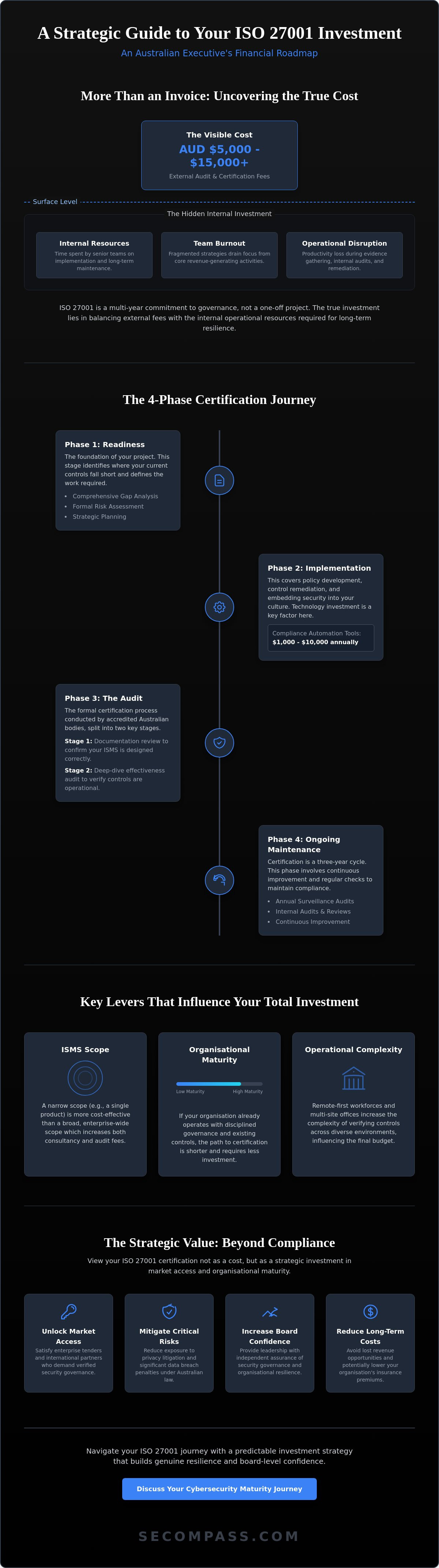
The journey toward certification is a structured progression through four distinct phases: readiness, implementation, the formal audit, and ongoing maintenance. Each stage carries its own financial profile, and understanding these nuances is essential for accurate budgeting. While many global estimates use generic figures, Australian organisations must account for local market rates and the specific expectations of JASANZ-accredited certification bodies. Understanding the Investment requires a view that extends beyond the initial certificate to the total cost of ownership over a three-year cycle.
Phase 1 and 2: Readiness and Implementation
The foundation of your project rests on a comprehensive gap analysis and a formal risk assessment. These activities identify where your current controls fall short of the standard and define the technical and administrative work required. This phase also includes the development of your documentation suite and the delivery of staff awareness training, which are critical for embedding security into your organisational culture. Technology plays a dual role here. While compliance automation tools can range from $1,000 to $10,000 annually, they often reduce the manual labour required to maintain evidence, provided they are integrated correctly into your existing workflows.
Phase 3 and 4: The Audit and Ongoing Maintenance
The formal certification process is split into Stage 1 and Stage 2 audits. Stage 1 is a documentation review where the auditor confirms your Information Security Management System (ISMS) is designed correctly. Stage 2 is the deep-dive effectiveness audit. For a mid-sized Australian firm, external audit fees typically range from AUD 5,000 to AUD 15,000, depending on complexity and headcount. It is important to factor in administrative overheads and potential travel costs if on-site verification is required.
Maintenance is where many budgets falter. You are required to conduct annual surveillance audits in years two and three, which generally cost between AUD 3,000 and AUD 10,000 per year. Additionally, mandatory internal audits must be performed by an independent party to ensure the system remains compliant. Many leaders find that engaging ISO 27001 Readiness & Implementation specialists early in the process helps to streamline these phases and avoid the costly rework associated with major non-conformities. If you are beginning to map out your timeline, you may wish to schedule a security assessment to clarify your specific requirements.
Optimising Your Compliance Budget: The Strategic Value of Advisory Support
While the direct cost of ISO 27001 certification includes visible audit fees, the most significant variable in your budget is the implementation path you select. Organisations generally choose between a self-guided DIY approach, traditional high-cost consultancies, or the Virtual CISO (vCISO) model. While the DIY route often appears cost-effective on paper, it frequently carries a heavy internal resource tax. This hidden expense arises when senior engineering or legal talent is diverted from revenue-generating product roadmaps to manage complex policy documentation and control mapping.
A strategic advisory partner ensures that your investment results in a scalable security posture rather than a collection of static documents. By designing a system that aligns with other frameworks like SOC 2 from the outset, you avoid the expensive rework typically required when a business matures and faces new compliance demands. This forward-looking oversight allows leadership to maintain a clear view of the cost of ISO 27001 certification across its entire lifecycle, ensuring that every dollar spent contributes to long-term operational resilience.
The Virtual CISO Advantage for Mid-Market Firms
For mid-market Australian firms, appointing a full-time, high-salary CISO is often a premature financial burden. The vCISO model provides the same level of executive leadership and "quiet expertise" at a fraction of the cost. This approach allows your organisation to navigate the audit process without the friction of trial and error. An experienced advisor anticipates auditor expectations, ensuring that Stage 1 and Stage 2 assessments proceed smoothly and without the need for costly follow-up audits.
Integrating Privacy and Security for Greater Efficiency
Preparation for ISO 27001 provides a natural opportunity to address evolving Australian regulatory requirements. By aligning your security implementation with Virtual Data Protection Officer (vDPO) services, you can meet the stringent demands of the AU Privacy Act through a single, unified governance programme. Integrated governance ensures that every dollar spent on security maturity also strengthens your privacy posture, effectively reducing the compliance cost per framework.
If you are ready to move beyond technical checklists and build a resilient security foundation, we invite you to discuss your cybersecurity maturity journey with our advisory team.
Establishing a Resilient Foundation for Future Growth
Navigating the cost of ISO 27001 certification requires a shift in perspective. It is not merely a regulatory hurdle, but a strategic framework for long-term organisational maturity. By acknowledging the hidden internal resource tax and choosing a guided implementation path, Australian businesses can avoid the friction of rework and the potential burnout of senior talent. The investment you make today should serve as a scalable foundation that supports your growth into new markets and simplifies future compliance requirements like SOC 2.
With local expertise based in Melbourne and Auckland, our team provides the specialised vCISO leadership necessary to oversee this journey with precision. We have a proven track record in guiding firms through ISO 27001 and SOC 2 readiness, ensuring your security posture remains robust and aligned with global expectations. We invite you to discuss your cybersecurity maturity journey with our expert advisors to clarify your roadmap and budget. Building a culture of security is a significant milestone, and we look forward to helping you lead your organisation toward a more secure and resilient future.
Frequently Asked Questions
Is ISO 27001 certification a one-time cost for Australian businesses?
No, the initial cost of ISO 27001 certification represents the start of a three-year governance cycle. After the primary audit, your organisation must complete annual surveillance audits in years two and three to maintain its certified status. These assessments ensure the management system remains mature and responsive to new threats, with a full recertification process occurring every three years to renew the certificate.
How much of the ISO 27001 implementation can we reasonably do ourselves?
While your internal team can technically manage the entire project, the success of a DIY approach depends on their existing familiarity with the framework. The primary challenge is the opportunity cost of pulling senior engineers or legal counsel away from revenue-generating work. Most firms find that partnering with a strategic advisor to lead the implementation reduces the risk of audit failure and prevents internal burnout.
What is the typical timeframe for a return on investment for ISO 27001?
Most Australian organisations realise a return on their investment within 12 to 18 months of formal certification. This timeframe is typically accelerated by the ability to meet the stringent security requirements of enterprise tenders and international partnerships. Beyond revenue growth, the long-term ROI is found in reduced cyber insurance premiums and the operational efficiency gained by replacing ad-hoc security tasks with a structured management system.
Can we combine ISO 27001 and SOC 2 audits to save on costs?
You can certainly align both frameworks to create significant cost and time efficiencies. Because ISO 27001 and SOC 2 share many foundational requirements, such as risk management and access controls, you can design a single set of controls that satisfies both standards. This integrated strategy reduces the total cost of ISO 27001 certification and SOC 2 by streamlining evidence collection and minimising the duration of external audits.

Article by
Jatinder Oberoi
Founder and Principal Consultant at SeComPass, a cybersecurity, privacy, governance, and compliance advisory firm supporting organisations across Australia and New Zealand. With extensive experience in cybersecurity leadership, risk management, ISO 27001, SOC 2, privacy, and governance advisory, he works closely with executive teams to help organisations strengthen operational resilience and improve cybersecurity maturity. Known for his pragmatic and business-focused approach, Jatinder specialises in translating complex cybersecurity and compliance challenges into clear, actionable strategies for leadership teams. His work focuses on helping organisations align security initiatives with business objectives, governance expectations, regulatory obligations, and long-term resilience outcomes. Through SeComPass, he regularly advises organisations on cybersecurity governance, AI risk, third-party risk, compliance frameworks, security leadership, and enterprise resilience. His writing and advisory approach emphasises clarity, practical decision-making, and sustainable security maturity over fear-driven cybersecurity messaging.