Cybersecurity Governance: A Strategic Framework for Australian and New Zealand Boards

In early 2026, many Australian directors found themselves reassessing their personal liability after the Cyber Security Rules 2025 mandated stricter standards for digital ecosystems. This shift signaled that the era of treating digital risk as a technical IT issue has ended, placing the responsibility firmly within the boardroom. You likely find the influx of technical jargon from your security teams exhausting, especially when trying to reconcile it with the increasing pressure from regulators like ASIC or the New Zealand Privacy Amendment Act 2025. It's natural to feel a sense of uncertainty when your reputation and personal liability are tethered to complex systems you don't directly manage.
This article provides a strategic roadmap to transition your approach to Cybersecurity Governance from a reactive hurdle into a robust leadership framework. You'll learn how to move beyond technical oversight to establish a discipline that protects your brand and enables sustainable business growth. We will outline the specific oversight roles required of modern boards and offer a framework that aligns security maturity with your primary business objectives, ensuring you meet the latest regulatory expectations across Australia and New Zealand with confidence.
Key Takeaways
- Distinguish between governance and management to ensure the board maintains strategic oversight without becoming lost in technical execution.
- Identify the critical cross-functional stakeholders from legal, finance, and operations needed to form an effective governance committee.
- Master the art of Cybersecurity Governance by establishing reporting lines that translate complex technical data into clear, business-aligned risk metrics.
- Explore how a robust leadership framework simplifies the path to achieving global certifications such as ISO 27001 and SOC 2.
- Learn to mitigate third party and supply chain risks, ensuring your organisation remains resilient against these increasingly common threat vectors.
Table of Contents
-
Defining Cybersecurity Governance as a Strategic Leadership Mandate
-
Establishing a Robust Governance Structure for Your Organisation
-
Aligning Governance with Compliance to Drive Business Growth
Defining Cybersecurity Governance as a Strategic Leadership Mandate
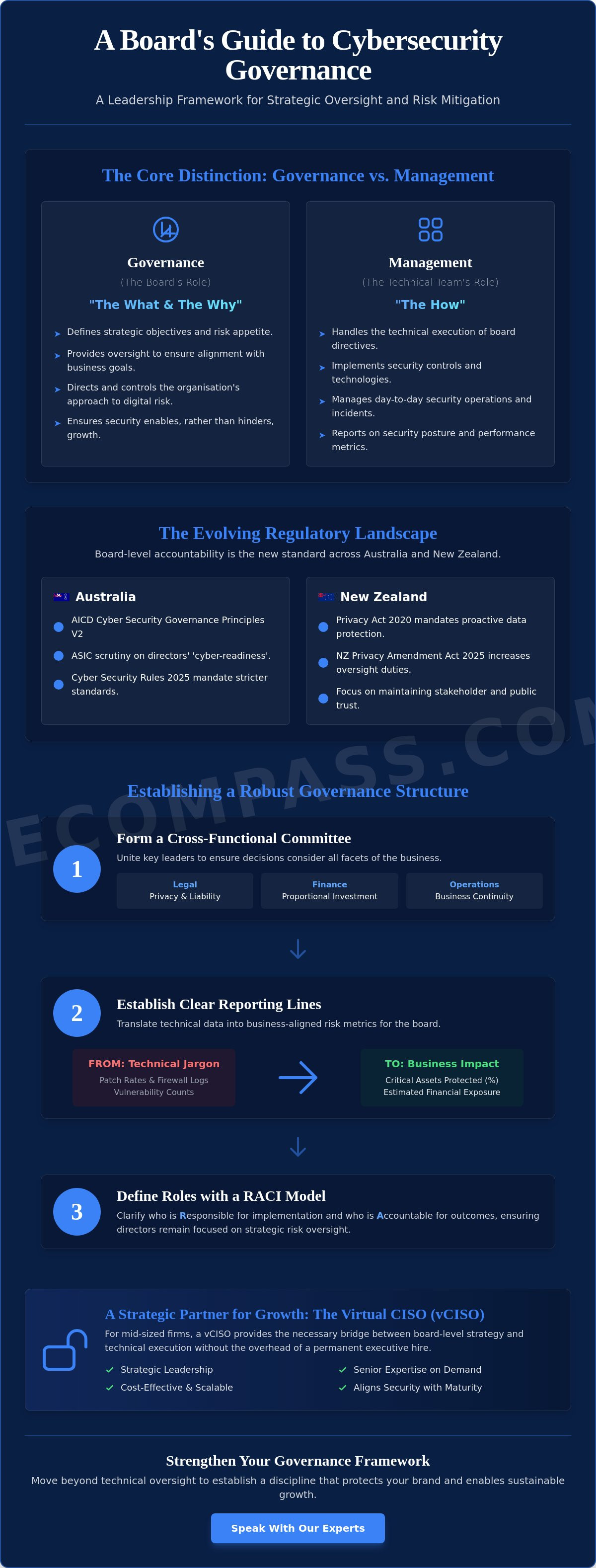
Cybersecurity governance is the formal system by which an organisation is directed and controlled to manage digital risk. It is often confused with security management, yet the two serve distinct and vital functions. Governance establishes the "what" and the "why," defining the organisation's risk appetite and strategic objectives. Management, conversely, handles the "how," focusing on the technical execution of those directives. Without a clear governance framework, technical teams often work in a vacuum, lacking the business context required to prioritise investments effectively.
When leadership treats security as a core business strategy, it ceases to be an isolated IT expense. Instead, it becomes a mechanism for operational resilience and brand protection. Effective Cybersecurity Governance ensures that every digital investment aligns with the company's broader mission, transforming security from a defensive hurdle into a competitive advantage that enables growth and innovation.
The Evolving Regulatory Landscape in Australia and New Zealand
Expectations for local boards have shifted significantly over the last few years. The AICD Cyber Security Governance Principles Version 2 have set a clear benchmark for what constitutes reasonable oversight in the Australian boardroom. In New Zealand, the Privacy Act 2020 mandates proactive data protection oversight, while Australian regulators like ASIC are increasingly scrutinising directors' "cyber-readiness" following high-profile incidents. This scrutiny is part of a broader trend within global cybersecurity regulation frameworks where personal accountability is the new standard. Boards can no longer delegate risk entirely to technical teams; they must lead the maturity journey themselves to ensure compliance and maintain stakeholder trust.
Governance vs. Technical Controls
A common misconception among executives is that increasing the IT budget or purchasing more software equates to better security. While technical controls are necessary, they are not a substitute for a robust governance framework. Leadership's primary role is to establish a risk appetite that guides these investments. This ensures that resources are allocated to protect the assets that truly drive business value rather than simply checking a box. For many organisations, engaging a vCISO provides the necessary bridge between board-level strategy and technical execution, ensuring that governance remains the priority while management handles the operational details.
Establishing a Robust Governance Structure for Your Organisation
Success in Cybersecurity Governance depends on a cross-functional committee rather than a siloed IT department. This group should include representatives from legal, finance, and operations to ensure every decision considers regulatory liability, fiscal impact, and operational continuity. Legal counsel provides essential oversight on privacy obligations, while finance ensures that security investments are proportionate to the identified risks. Operations leaders contribute by identifying which processes are most critical to the organisation's daily survival.
Clear reporting lines are the backbone of this structure. Boards require transparent, non-technical risk metrics that translate technical vulnerabilities into business impact. Instead of discussing patch rates or firewall logs, reports should focus on the percentage of critical assets protected or the estimated financial exposure of specific threat scenarios. This clarity allows directors to make informed decisions about resource allocation and risk acceptance.
Mid-sized firms often find that hiring a full-time CISO is not financially viable or necessary for their current scale. In these instances, a Virtual CISO (vCISO) serves as a strategic partner. They provide the high-level leadership required to drive governance efforts without the overhead of a permanent executive hire. This model allows organisations to access senior expertise that scales with their maturity level.
Defining Roles and Responsibilities
A clear RACI model is indispensable for managing cyber risk at the executive level. It defines who is responsible for implementation and who is ultimately accountable for the outcome. Understanding specific Board Cybersecurity Responsibilities ensures that directors remain focused on risk oversight and incident response readiness rather than getting bogged down in day-to-day management. The vCISO acts as the bridge here, translating technical realities into the strategic language of the boardroom to ensure alignment.
Measuring Governance Maturity
Transitioning from reactive firefighting to a proactive posture starts with a security maturity assessment. This process baselines your current effectiveness against recognised standards, allowing leadership to identify gaps and prioritise improvements based on actual risk. It transforms security from a series of ad-hoc projects into a measurable business discipline. To begin this transition, you may wish to schedule a security assessment to evaluate your organisation's current standing and define a clear path forward.
Aligning Governance with Compliance to Drive Business Growth
Strong Cybersecurity Governance does more than satisfy a regulator. It streamlines the path to prestigious certifications such as ISO 27001 and SOC 2. These aren't just badges of honour. They are essential requirements for entering high value enterprise markets. When your governance framework is already robust, the leap to formal certification becomes a natural progression rather than a frantic, expensive scramble. It ensures that your internal processes are already aligned with global expectations before the audit even begins.
Supply chain vulnerabilities now represent a primary vector for breaches in the Australian and New Zealand markets. Effective governance extends your oversight beyond your own perimeter, allowing you to manage third-party risks with precision. By formalising how you vet and monitor partners, you protect your reputation and ensure that a vendor's failure doesn't become your crisis. This proactive stance is a hallmark of a mature leadership team that understands the interconnected nature of modern business.
Demonstrating high maturity in your digital oversight builds immediate trust with enterprise partners. It often accelerates sales cycles by pre-empting the exhaustive security questionnaires that typically stall procurement. In this context, governance is a strategic investment in operational resilience and a powerful engine for business growth. It moves the conversation from "are we safe?" to "how can we safely expand?"
Compliance as a Strategic Business Asset
Adopting an AI Governance Framework is a prime example of how leadership enables safer innovation. It provides the guardrails needed to experiment with emerging technologies without compromising privacy or security. Global standards offer a common language, making it easier to discuss risk and build credibility with international stakeholders and investors who expect a certain level of systemic integrity. This alignment reduces friction when entering new jurisdictions or seeking capital.
The Path Forward for Executive Leadership
Boards can take immediate steps to formalise their oversight by reviewing current reporting structures and identifying gaps in stakeholder representation. Moving from a checklist mentality to a consultative approach ensures that your security posture evolves alongside your business objectives. It is about building a culture where security is seen as a shared responsibility rather than a burden. We invite leadership teams to book a strategic briefing with our advisors to discuss your maturity journey and ensure your governance framework is built for long-term stability.
Securing Your Organisation's Future through Strategic Oversight
Transitioning from a technical view of digital risk to a robust model of Cybersecurity Governance is no longer optional for Australian and New Zealand boards. By establishing clear reporting lines and cross-functional committees, you ensure that security maturity aligns with your broader business objectives. This approach doesn't just satisfy regulators like ASIC; it builds the necessary trust to accelerate sales and enter new markets with confidence. Whether you are aiming for ISO 27001 readiness or managing complex supply chain risks, the focus must remain on leadership accountability and operational resilience.
SeComPass provides specialised vCISO leadership and expert advisory for SOC 2 and ISO 27001 compliance, helping AU and NZ enterprises navigate these challenges with strategic clarity. Our focus is always on risk reduction and business enablement, ensuring your security framework supports long-term growth rather than acting as a hurdle. To begin your maturity journey or refine your current oversight structure, you can schedule a strategic cybersecurity governance briefing with our experts. Taking this step now will position your organisation as a resilient and trusted leader in your industry.
Frequently Asked Questions
What is the difference between cybersecurity governance and cybersecurity management?
Governance focuses on the strategic "what" and "why" of an organisation's security posture, while management handles the tactical "how" of implementation. In the boardroom, governance ensures that security objectives align with business growth and regulatory obligations. Management involves the daily operation of technical controls and security software. Effective oversight requires directors to focus on high-level outcomes and risk appetite rather than getting lost in the technical details of execution.
How often should the board receive reports on cybersecurity governance?
Most Australian boards receive formal briefings quarterly, though high-growth or high-risk organisations often require monthly updates. The frequency should allow for meaningful analysis of risk trends rather than just snapshots of technical activity. These reports must provide clear, non-technical metrics that reflect the organisation's current maturity and progress toward strategic goals. During significant digital transformations or major regulatory shifts, more frequent touchpoints ensure that leadership remains informed and accountable.
Does a small or medium-sized business really need a formal governance framework?
Every business requires a formal framework regardless of its size, as smaller firms are frequently targeted as entry points into larger supply chains. Beyond risk reduction, a structured approach to Cybersecurity Governance is often a prerequisite for winning enterprise contracts or achieving certifications like ISO 27001. A formal framework allows smaller teams to prioritise limited resources effectively, ensuring that the most critical business assets receive the highest level of protection without unnecessary spending.
How does cybersecurity governance impact my liability as a company director in Australia?
Australian company directors face increasing personal liability for cyber incidents if they fail to demonstrate "reasonable" oversight of their organisation's digital risk. Regulators like ASIC now view cybersecurity as a fundamental fiduciary duty rather than a niche IT concern. If a breach occurs and it is found that the board lacked a structured governance framework, directors could be held accountable for failing to exercise due care and diligence. Proactive governance serves as a primary defence by documenting the board's informed decision-making process.

Article by
Jatinder Oberoi
Founder and Principal Consultant at SeComPass, a cybersecurity, privacy, governance, and compliance advisory firm supporting organisations across Australia and New Zealand. With extensive experience in cybersecurity leadership, risk management, ISO 27001, SOC 2, privacy, and governance advisory, he works closely with executive teams to help organisations strengthen operational resilience and improve cybersecurity maturity. Known for his pragmatic and business-focused approach, Jatinder specialises in translating complex cybersecurity and compliance challenges into clear, actionable strategies for leadership teams. His work focuses on helping organisations align security initiatives with business objectives, governance expectations, regulatory obligations, and long-term resilience outcomes. Through SeComPass, he regularly advises organisations on cybersecurity governance, AI risk, third-party risk, compliance frameworks, security leadership, and enterprise resilience. His writing and advisory approach emphasises clarity, practical decision-making, and sustainable security maturity over fear-driven cybersecurity messaging.