
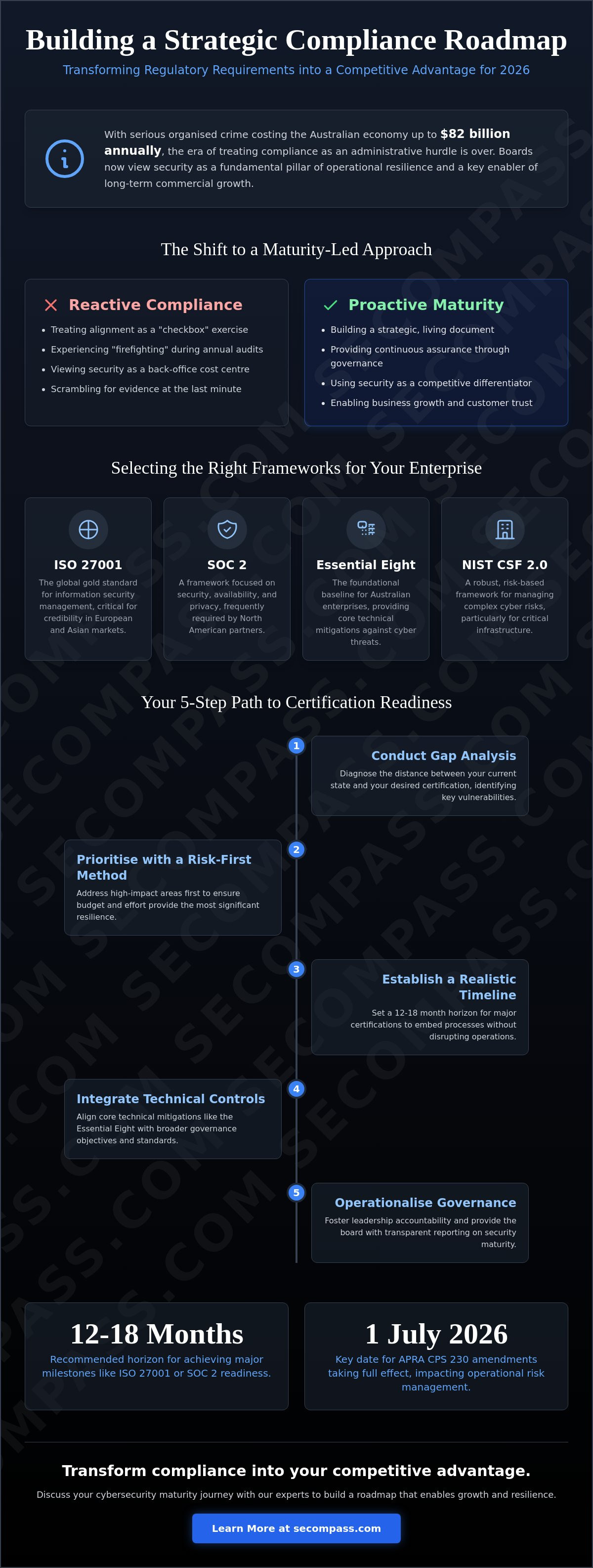
With serious organised crime now costing the Australian economy up to $82 billion annually, the era of treating regulatory alignment as a mere administrative hurdle has officially ended. Boards no longer view security as a back-office function; they see it as a fundamental pillar of operational resilience. You likely feel the weight of managing a compliance roadmap that must account for ISO 27001, SOC 2, and the Essential Eight, especially as the APRA CPS 230 amendments take full effect on 1 July 2026. It is a complex landscape where communicating the value of these frameworks to your directors often feels as challenging as the technical implementation itself.
We recognise that limited internal expertise can make complex certification projects feel like a moving target. This executive briefing offers a structured approach to transforming rigid regulatory requirements into a distinct strategic advantage for your organisation. We will outline how to establish a prioritised timeline for certification that reduces third-party risk, secures customer trust, and ensures full alignment with the Australian Privacy Act and NZ Privacy Act 2020. By the end of this guide, you will have a clear path to maturing your governance posture and enabling long-term commercial growth.
Key Takeaways
- Learn how to develop a compliance roadmap that serves as a strategic living document, aligning your technical controls with the organisation's broader risk appetite.
- Understand the transition from reactive checkbox exercises to a proactive maturity model tailored for the 2026 Australian regulatory landscape.
- Identify the most effective frameworks for your enterprise, including the interplay between international standards like ISO 27001 and local requirements such as the Essential Eight.
- Discover the process of conducting a thorough gap analysis to define a clear, prioritised timeline for reaching your desired certification state.
- Establish governance structures that foster leadership accountability and provide the board with transparent reporting on security maturity and risk reduction.
Establishing the Foundations of a Strategic Compliance Roadmap
In the 2026 Australian regulatory environment, a compliance roadmap isn't a static checklist or a one-off project. It's a dynamic strategic document that bridges the gap between your technical controls and your organisation's broader risk appetite. Understanding the nuances of Regulatory Compliance is no longer just about meeting minimum standards; it's about building a framework that supports sustainable growth. This requires early engagement with key stakeholders, including executive leadership, legal counsel, and the board.
A proactive approach ensures that local requirements, such as the Australian Privacy Act and the NZ Privacy Act 2020, are woven into the initial vision. When these obligations are integrated early, they cease to be hurdles and instead become part of the organisational DNA. Engaging a vCISO can provide the steady oversight needed to navigate these overlapping frameworks without overwhelming your internal teams.
Why Maturity Trumps Mere Compliance
A maturity-led approach moves your organisation away from the exhaustion of "firefighting" during annual audits. Instead of scrambling for evidence at the eleventh hour, a mature system provides continuous assurance through embedded governance. This shift doesn't just satisfy regulators. It serves as a powerful competitive differentiator. To see how professional digital strategy can help drive this organisational efficiency, check out Business Analysis & Solutions. When bidding for major enterprise contracts, demonstrating a verified level of security maturity often provides the confidence partners need to secure long-term agreements.
Setting Realistic Milestones for 2026
Building a resilient posture is a marathon, not a sprint. We typically recommend a 12 to 18 month horizon for achieving major milestones like ISO 27001 or SOC 2 readiness. This timeframe allows your team to embed new processes naturally without disrupting core business operations. The objective is to balance immediate risk mitigation, such as addressing the Essential Eight, with long-term strategic objectives that enable business enablement and operational resilience.
Framework Selection and the Gap Analysis Process
Selecting the right frameworks is a pivotal decision that dictates the trajectory of your compliance roadmap. A common mistake is attempting to adopt every available standard simultaneously, which often leads to resource exhaustion and operational friction. Instead, we advocate for a comprehensive gap analysis. This diagnostic process identifies the distance between your current state and your desired certification, allowing you to prioritise controls based on a risk-first methodology. By addressing high-impact vulnerabilities first, you ensure that budget and effort are allocated where they provide the most significant resilience.
Understanding the cost of ISO 27001 certification is a critical part of this planning phase, as it helps manage board expectations regarding multi-year investments. If you are unsure which path aligns with your growth strategy, you might schedule a security assessment to clarify your requirements.
Choosing the Right Standard for Your Market
For Australian SaaS organisations looking toward international expansion, the choice between ISO 27001 and SOC 2 is often driven by target markets. ISO 27001 remains the gold standard for global credibility, particularly in Europe and Asia. Conversely, SOC 2 is frequently required by North American partners. For those managing critical infrastructure, the NIST CSF 2.0 offers a robust framework for managing complex cyber risks. These standards should be viewed as complementary layers rather than competing requirements.
The Role of the Essential Eight in Your Roadmap
The ASD Essential Eight serves as a foundational baseline for almost every Australian enterprise. Integrating an Essential Eight Compliance Roadmap into your broader strategy ensures that core technical mitigations are robust. We recommend a phased approach, moving through maturity levels 1 to 3 based on your specific threat profile. This tiered progression allows for steady improvement while maintaining alignment with broader certifications, ensuring your technical baseline supports your overarching governance goals.
Operationalising the Roadmap through Governance and Oversight
A well-defined compliance roadmap only delivers value when it is actively managed through a robust governance structure. This stage requires moving beyond the technical implementation of controls to establishing clear lines of accountability within the executive team. A successful Compliance program ensures that every milestone is tracked and reported to the board with transparency. This level of oversight provides directors with the assurance they need to confirm that security maturity is progressing in line with the organisation's risk tolerance.
Strategic leadership is often the missing link in complex certification projects. Engaging a Virtual CISO (vCISO) provides your organisation with the executive-level guidance necessary to navigate these requirements without the overhead of a full-time hire. This advisor acts as a bridge between technical teams and the board, ensuring that compliance is viewed as a business enabler rather than a technical burden. It also shifts the focus from "point-in-time" audit preparation toward a model of continuous monitoring and resilience.
Maintaining Momentum with Managed Leadership
Many organisations suffer from a "post-audit slump" where security controls are neglected once the certificate is on the wall. Ongoing advisory services prevent this decline by maintaining a steady cadence of reviews and updates. For many Australian enterprises, this involves transitioning from project-based readiness to an evergreen model like Privacy as a Service. This approach ensures that your privacy and security posture evolves alongside legislative changes, such as the upcoming 2026 reforms.
Measuring Success Beyond the Certificate
True success is measured by actual risk reduction rather than just a badge of compliance. Effective KPIs should focus on operational resilience, such as the time taken to detect and remediate control failures. Additionally, reporting on third-party risk management (TPRM) has become a vital outcome of any modern compliance roadmap. By demonstrating rigorous oversight of your supply chain, you build a foundation of trust that resonates with both customers and regulators.
Securing Your Competitive Edge through Strategic Maturity
Navigating the 2026 regulatory landscape requires a shift from reactive task management to a culture of continuous assurance. By establishing a robust compliance roadmap, your organisation does more than just satisfy auditors; it builds the operational resilience necessary to win and retain enterprise contracts. We have explored how a phased approach to frameworks ensures that technical controls always align with your commercial objectives and risk appetite.
True progress depends on steady leadership and local expertise. With offices in Melbourne and Auckland, our team provides specialised expertise in ISO 27001, SOC 2, and the Essential Eight to help you navigate these complexities. Our strategic partnership approach focuses on business enablement, ensuring that your security posture supports your long-term growth. If you are ready to move beyond the checklist and elevate your organisational maturity, we invite you to discuss your cybersecurity maturity journey with our expert advisors. Building a more resilient future starts with a single, well-planned step.
Frequently Asked Questions
What is the difference between a compliance program and a compliance roadmap?
A compliance program is the overarching framework of policies, processes, and controls that an organisation maintains to meet its legal and ethical obligations. In contrast, a compliance roadmap is the strategic, time-bound plan that defines the specific milestones, resource allocations, and priorities required to reach a desired state of maturity. While the program represents your ongoing governance state, the roadmap provides the navigational path to reach that destination.
How long does it typically take to complete a compliance roadmap for ISO 27001?
Completing the journey toward ISO 27001 certification typically requires a 12 to 18 month horizon for most Australian enterprises. This duration allows for a comprehensive gap analysis, the design of technical controls, and the collection of operational evidence needed for a successful audit. A measured pace ensures that security practices are naturally integrated into your business operations, which prevents the disruption often caused by rushed, "point-in-time" compliance efforts.
Does our Australian organisation need both SOC 2 and ISO 27001?
The decision to pursue both SOC 2 and ISO 27001 depends on your organisation's commercial objectives and geographic footprint. ISO 27001 is the global standard for information security, providing broad credibility across Australia, Europe, and Asia. If your enterprise is a SaaS provider targeting the North American market, you will likely find that US partners specifically mandate a SOC 2 report. We often suggest a phased approach to avoid over-extending internal resources.
Can we manage a compliance roadmap without a full-time CISO?
You can effectively manage a compliance roadmap without a full-time hire by engaging a Virtual CISO (vCISO). This advisory model delivers the same level of strategic oversight and board-level reporting as a permanent executive but with greater flexibility. A vCISO provides the technical mastery and leadership experience required to navigate complex frameworks like the Essential Eight, allowing your internal teams to remain focused on delivering core business value.

Article by
Jatinder Oberoi
Founder and Principal Consultant at SeComPass, a cybersecurity, privacy, governance, and compliance advisory firm supporting organisations across Australia and New Zealand. With extensive experience in cybersecurity leadership, risk management, ISO 27001, SOC 2, privacy, and governance advisory, he works closely with executive teams to help organisations strengthen operational resilience and improve cybersecurity maturity. Known for his pragmatic and business-focused approach, Jatinder specialises in translating complex cybersecurity and compliance challenges into clear, actionable strategies for leadership teams. His work focuses on helping organisations align security initiatives with business objectives, governance expectations, regulatory obligations, and long-term resilience outcomes. Through SeComPass, he regularly advises organisations on cybersecurity governance, AI risk, third-party risk, compliance frameworks, security leadership, and enterprise resilience. His writing and advisory approach emphasises clarity, practical decision-making, and sustainable security maturity over fear-driven cybersecurity messaging.