
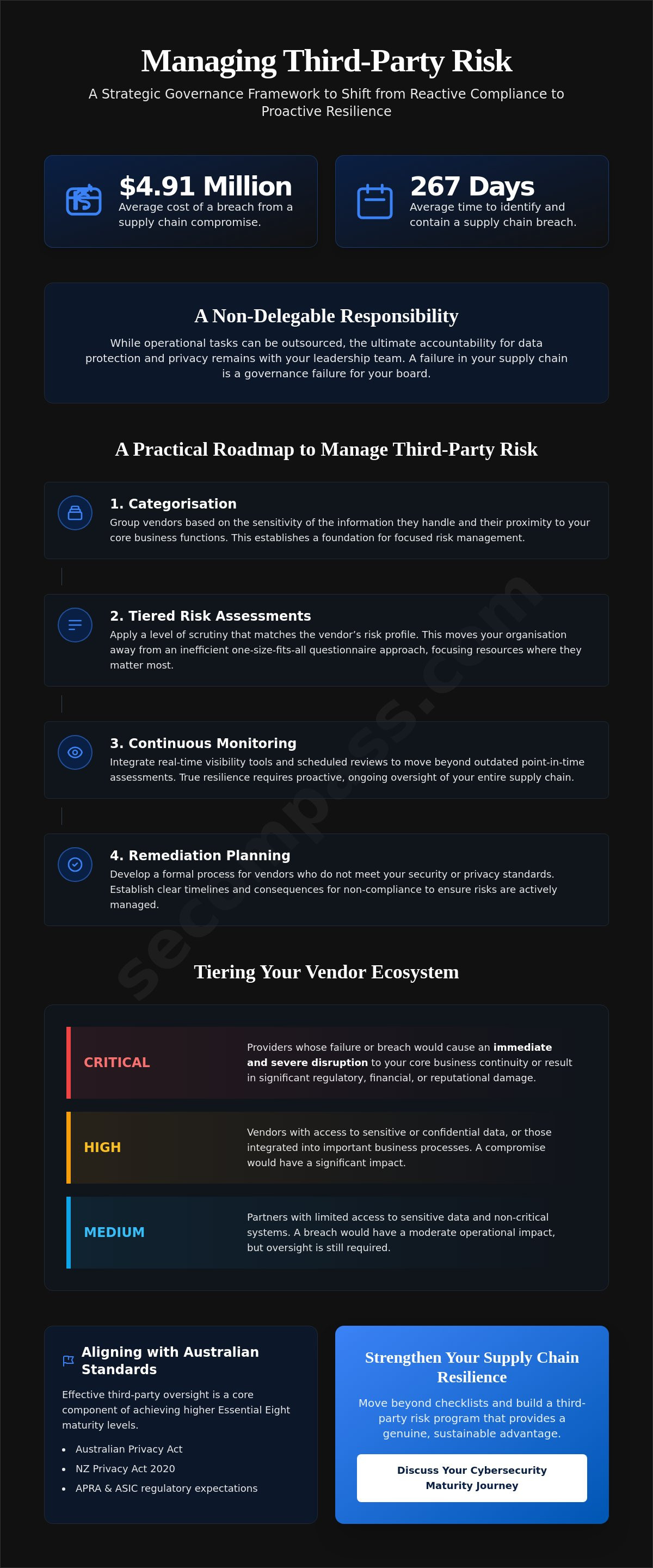
In 2025, breaches originating from a supply chain compromise cost organisations an average of $4.91 million and took a staggering 267 days to resolve. These figures represent more than just financial loss; they highlight a systemic gap in how many leadership teams oversee their extended enterprise. For most executives, the relentless stream of vendor questionnaires and the opaque nature of fourth-party risks feel like a drain on resources rather than a protective measure. You likely feel the mounting pressure from regulators like ASIC and APRA to move beyond simple checklists toward genuine operational resilience.
It is understandable to view these requirements as a hurdle, yet the most resilient firms recognise that robust oversight is actually a business enabler. This guide will show you how to manage third party risk by shifting from a reactive compliance mindset to a strategic governance framework that strengthens your organisation. We will explore how to build a scalable model that satisfies regulatory demands while turning vendor oversight into a clear, sustainable advantage for your leadership team.
Key Takeaways
- Recognise that while operational tasks are outsourced, the ultimate accountability for data protection and privacy remains a non-delegable responsibility for your leadership team.
- Discover how to manage third party risk by establishing a clear categorisation model that prioritises vendors based on their access to sensitive information and critical business functions.
- Implement tiered risk assessments to ensure your resources are focused on high-impact partners, moving away from an inefficient and overwhelming one-size-fits-all questionnaire approach.
- Transform vendor relationships into strategic security partnerships, fostering a culture of mutual resilience rather than mere checklist compliance.
- Integrate Privacy Impact Assessments (PIAs) into your procurement process to proactively address the privacy implications of new third-party software and platforms.
Table of Contents
Establishing a Governance Framework for Third-Party Risk
To understand how to manage third party risk, one must first define the scope of the challenge. We define third-party risk as the potential for an external vendor, partner, or service provider to compromise your organisation’s integrity, security, or compliance. It is a common misconception that outsourcing a service also outsources the risk. While the operational tasks are handled by a third party, the accountability for data protection and privacy remains firmly with your leadership team.
Effective governance requires aligning your strategy with recognised international standards, such as ISO 27001 or SOC 2. This creates a consistent language of risk across the enterprise. Central to this is a clear risk appetite statement. This document should dictate which vendor relationships require the highest level of scrutiny based on their access to your most sensitive data.
To better understand this concept, watch this helpful video:
The Governance Implications of Transitive Trust
Regulators increasingly view a vendor’s security posture as an extension of your own. This concept of transitive trust means that a failure at a third or fourth-party level is still a governance failure for your board. We are seeing a necessary shift from reactive vendor checking to proactive ecosystem governance. This involves moving away from static annual questionnaires toward a model that considers how to manage third party risk through continuous oversight of the entire supply chain.
Accountability and Leadership Roles
The board holds the ultimate responsibility for overseeing the supply chain risk profile. They must ensure that the organisation isn't just collecting certificates but is actively managing threats. Many firms find that engaging a virtual CISO provides the specialised oversight needed to bridge the gap between high-level governance and practical risk reduction. This role ensures that third-party programs are not just compliance exercises; they are integrated into the broader business strategy to ensure long-term stability.
A Practical Roadmap to Manage Third Party Risk
Building a resilient supply chain requires more than just due diligence; it requires a structured lifecycle. To understand how to manage third party risk effectively, your team must move beyond the 'set and forget' mentality of annual reviews. The roadmap begins with a comprehensive audit of your vendor landscape to identify every provider with access to your systems or data.
-
Categorisation: Group vendors based on the sensitivity of the information they handle and their proximity to your core business functions.
-
Tiered Risk Assessments: Apply a level of scrutiny that matches the vendor’s importance, ensuring your resources are focused on the highest areas of concern.
-
Continuous Monitoring: Integrate real-time visibility tools rather than relying on a single point-in-time annual questionnaire that quickly becomes outdated.
-
Remediation: Develop a formal process for vendors who do not meet your security or privacy standards, establishing clear timelines for improvement.
Tiering Your Vendor Ecosystem
A classification system, typically divided into Critical, High, and Medium risk categories, allows your team to focus their energy where it matters most. By understanding how to manage third party risk through tiered oversight, leadership can ensure that compliance efforts are both efficient and effective. A critical vendor is any provider whose sudden failure or breach would result in an immediate and severe disruption to your core business continuity.
Aligning with Australian Standards
Within the Australian and New Zealand landscape, third-party oversight is a core component of achieving higher Essential Eight maturity levels . Contracts must also reflect the specific requirements of the Australian Privacy Act and the NZ Privacy Act 2020. This ensures that your partners are legally bound to the same data handling standards that your own organisation maintains. If you are unsure where your current framework sits against these expectations, you might consider how to discuss your cybersecurity maturity journey with a specialist advisor.
Driving Strategic Maturity and Operational Resilience
Achieving maturity in your vendor risk program requires a fundamental shift in perspective. Instead of viewing oversight as a series of hurdles, leading organisations treat it as a collaborative partnership. When you understand how to manage third party risk through the lens of business enablement, you move away from simple box-checking. It's about building a culture where security is a shared value between you and your key suppliers. This approach turns compliance from a cost centre into a strategic asset.
Implementing Privacy Impact Assessments (PIAs) is a practical step in this evolution. Before onboarding any new third-party software that handles personal information—such as an omni-channel payment platform like strictlyzero.com—a PIA ensures that privacy risks are identified and mitigated at the design stage. This proactive stance doesn't just satisfy legal requirements. It builds a foundation of trust that protects your brand reputation over the long term.
Reporting these efforts to the board is equally critical. By presenting clear metrics that track the reduction of high-risk vendor findings, leadership can demonstrate a maturing security posture. This transparency gives the board the assurance they need to support strategic growth while knowing that liability is being actively managed. A robust third-party program also serves as a significant competitive advantage when your organisation pursues its own SOC 2 or ISO 27001 certifications.
The Role of Assurance in Business Growth
A mature risk framework shouldn't slow down the business. It actually accelerates it. By having a repeatable, documented process for how to manage third party risk, you can onboard new partners and customers with greater speed and confidence. Choosing the right framework is essential for this scalability. You can explore the differences in our ISO 27001 vs SOC 2 comparison to determine which standard best supports your specific growth objectives.
Partnering for Strategic Oversight
Managing a complex risk landscape often requires a dedicated security leadership home. This centralised approach ensures that your governance strategy remains consistent even as your vendor ecosystem expands. We recommend a consultative approach to vendor remediation. Rather than taking a purely punitive stance when a supplier falls short, work with them to improve their maturity. This collaborative effort leads to more sustainable security outcomes and a more resilient supply chain for everyone involved.
Securing Your Extended Enterprise for Future Growth
Mastering the complexities of a modern supply chain requires shifting from a compliance-heavy mindset to one of strategic oversight. We have explored how a robust governance framework ensures that while services are outsourced, your leadership team retains ultimate accountability for data integrity. By implementing a tiered roadmap and moving toward continuous monitoring, your organisation can replace overwhelming questionnaires with a scalable, risk-based approach.
Ultimately, learning how to manage third party risk is about more than just avoiding regulatory penalties. It's about creating a resilient foundation that supports rapid business growth and builds transitive trust with your own clients. Our expert vCISO leadership in Melbourne and Auckland provides specialised advisory for frameworks like ISO 27001, SOC 2, and NIST, focusing on practical risk reduction and business enablement.
We invite you to discuss your cybersecurity maturity journey with our experts today. Taking a proactive approach to your vendor ecosystem is a decisive step toward long-term stability and competitive advantage. We are here to guide you through every stage of that evolution with clarity and confidence.
Frequently Asked Questions
What is the difference between a vendor and a third party in risk management?
A vendor is a specific type of provider that sells goods or services to your firm, whereas a third party is a broader term encompassing any external entity with a business relationship. This includes partners, affiliates, and even non-commercial entities. When considering how to manage third party risk, leadership must look beyond simple procurement lists. This ensures that every external touchpoint, from cloud hosting to joint ventures, is accounted for within your governance framework.
How often should we conduct third-party risk assessments for critical vendors?
Critical vendors should undergo a formal risk assessment at least once a year, though the industry is moving toward continuous monitoring. Relying on a point-in-time check is no longer sufficient for high-impact partners who hold your most sensitive data. Establishing a cadence of regular reviews is a fundamental part of how to manage third party risk, as it allows your team to identify and remediate emerging threats before they can escalate into serious incidents.
Can we rely on a vendor's SOC 2 report instead of sending a questionnaire?
A SOC 2 Type 2 report offers valuable independent assurance, but it should serve as a starting point rather than a complete replacement for your own due diligence. These reports confirm that a vendor has controls in place; however, they may not address your specific regulatory obligations or unique operational risks. We recommend using the report to pre-fill your assessments, which saves time for both your team and the provider while maintaining oversight.
What are the most common third-party risks for Australian SaaS companies?
Australian SaaS companies frequently face risks related to data sovereignty, fourth-party dependencies, and compliance with local standards like the Essential Eight. There is also a growing concern regarding "shadow AI" where employees use unvetted third-party tools that may compromise intellectual property. Ensuring that your partners align with the Australian Privacy Act is essential for maintaining your reputation and meeting the governance expectations of enterprise-level customers and local regulators.

Article by
Jatinder Oberoi
Founder and Principal Consultant at SeComPass, a cybersecurity, privacy, governance, and compliance advisory firm supporting organisations across Australia and New Zealand. With extensive experience in cybersecurity leadership, risk management, ISO 27001, SOC 2, privacy, and governance advisory, he works closely with executive teams to help organisations strengthen operational resilience and improve cybersecurity maturity. Known for his pragmatic and business focused approach, Jatinder specialises in translating complex cybersecurity and compliance challenges into clear, actionable strategies for leadership teams. His work focuses on helping organisations align security initiatives with business objectives, governance expectations, regulatory obligations, and long term resilience outcomes. Through SeComPass, he regularly advises organisations on cybersecurity governance, AI risk, third party risk, compliance frameworks, security leadership, and enterprise resilience. His writing and advisory approach emphasises clarity, practical decision making, and sustainable security maturity over fear driven cybersecurity messaging.