
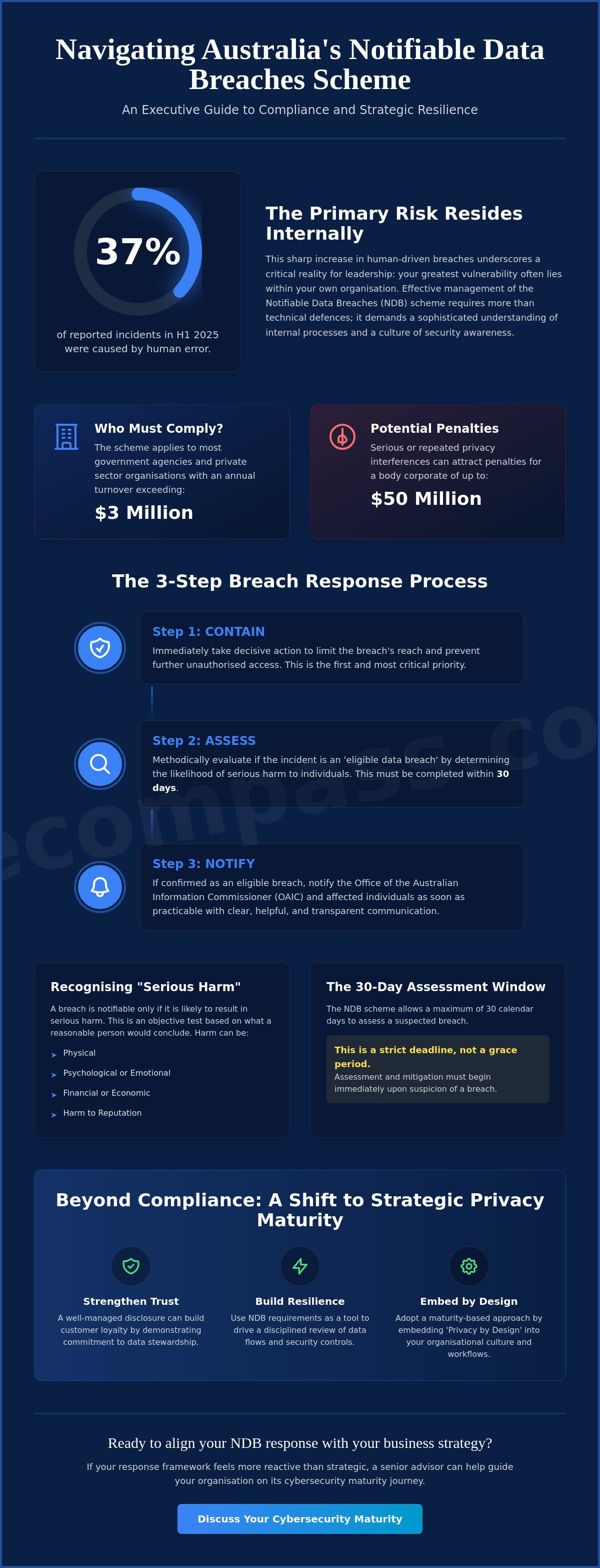
Human error was responsible for 37% of all reported incidents in the first half of 2025, a sharp increase from the previous reporting period. For an executive team, this statistic highlights that the primary risk often resides within the organisation's own walls rather than solely with external actors. Managing the notifiable data breaches scheme australia requires more than just technical defences. It demands a sophisticated understanding of how to balance regulatory obligations with business continuity. You likely feel the weight of potential 50 million dollar penalties or the ambiguity surrounding what actually constitutes serious harm. This pressure is understandable, yet it can be managed through a structured and calm approach to governance.
This briefing provides a comprehensive framework to help you navigate the NDB scheme with professional composure and strategic clarity. We will move beyond the fear of reputational damage to establish a repeatable process for breach assessment. By the end of this guide, you will understand how to align legal requirements with your broader business strategy, ensuring your response to any incident is both compliant and resilient.
Key Takeaways
- Determine whether your organisation meets the 3 million dollar annual turnover threshold and understand the specific accountability requirements for senior leadership.
- Establish a clear, repeatable process to contain, assess, and notify relevant parties during a suspected data breach incident.
- Align the notifiable data breaches scheme australia with your broader business strategy to ensure regulatory requirements support rather than hinder operational goals.
- Adopt a maturity-based approach to privacy by embedding Privacy by Design principles into your organisational culture and workflows.
Understanding the Notifiable Data Breaches Scheme and Leadership Accountability
The notifiable data breaches scheme australia serves as a central pillar of the national privacy framework. It requires organisations to be transparent when personal information is involved in a security incident. While the scheme primarily applies to Australian government agencies and private sector organisations with an annual turnover exceeding $3 million, its principles of accountability are becoming the standard for all professional entities. Understanding these Data Breach Notification Laws in Australia is essential for any executive, especially since serious or repeated interferences with privacy can now attract penalties exceeding $50 million for a body corporate.
Leadership teams often view notification as a reputational risk. In reality, a well managed disclosure can actually strengthen customer loyalty by demonstrating a commitment to data stewardship. By integrating these requirements into your broader business strategy, the scheme becomes a tool for building operational resilience. It forces a disciplined look at data flows and security controls, which ultimately drives higher levels of cybersecurity maturity. Many boards now utilise a vCISO to ensure these privacy obligations are woven into the organisation's risk management fabric rather than treated as an isolated IT issue.
The Threshold for Notification: Recognising Serious Harm
A breach becomes notifiable only when it is likely to result in serious harm to the individuals involved. This definition is broad. It encompasses physical, psychological, and emotional damage, as well as financial loss or harm to an individual's reputation. An eligible data breach occurs when there is unauthorised access to, unauthorised disclosure of, or a loss of personal information that could lead to such access or disclosure. Common examples include identity theft, financial fraud, or the exposure of sensitive health records.
The decision to notify rests on an objective test. You must ask whether a reasonable person in the organisation's position would conclude that the breach is likely to result in serious harm. This requires a methodical assessment of the types of data involved, the security measures in place, and the nature of the individuals affected. It's a strategic judgment call that demands executive oversight to ensure the response aligns with both legal mandates and the company's ethical values.
Navigating the Assessment and Notification Process
Execution under the notifiable data breaches scheme australia follows a specific three-step architecture: containment, assessment, and notification. Containment is the immediate priority. Leadership must ensure that the technical and operational teams take decisive action to limit the reach of the breach and prevent further unauthorised access. Once the immediate threat is neutralised, the focus shifts to a methodical assessment. This phase determines whether the incident qualifies as an eligible data breach by evaluating the likelihood of serious harm to individuals. A well-rehearsed incident response plan is vital here. It ensures that privacy obligations are not an afterthought but are integrated into the core of the organisation's crisis management framework.
If the assessment confirms an eligible breach, the organisation must notify the OAIC Notifiable Data Breaches Scheme and the affected individuals as soon as practicable. The quality of this communication is a direct reflection of your organisation's integrity. A strategic notification should be clear, helpful, and transparent. It must provide individuals with actionable steps to protect themselves, such as changing passwords or monitoring financial statements. This level of professional composure helps maintain trust even in challenging circumstances. If your current response framework feels reactive rather than strategic, you may wish to discuss your cybersecurity maturity journey with a senior advisor.
Managing the 30-Day Assessment Window
The scheme allows a maximum of 30 calendar days to assess a suspected breach. It is a common misconception to view this as a grace period or a target for commencement. The expectation is that the assessment begins immediately and proceeds with due diligence. Leadership plays a critical role in overseeing this window, ensuring that "reasonable steps" are taken to mitigate harm while the investigation is underway. A delayed assessment not only increases the risk to individuals but also heightens the potential for regulatory scrutiny. Proactive oversight ensures the process remains thorough without becoming stagnant, keeping the organisation on a path toward resolution and compliance.
Transitioning from Compliance to Strategic Privacy Maturity
Effective governance transforms the notifiable data breaches scheme australia from a regulatory hurdle into a strategic advantage. When privacy is treated as an isolated compliance activity, the organisation remains reactive and vulnerable. True maturity involves building a robust privacy programme where compliance is a natural byproduct of daily operations. This shift requires the adoption of Privacy by Design principles. By embedding privacy considerations into the initial stages of every project, you significantly reduce the likelihood and potential impact of future incidents. It’s about building a foundation that protects the business as it grows.
Aligning with international frameworks like ISO 27001 or NIST provides a structured roadmap for this journey. Regular security assessments ensure that your controls remain effective against evolving threats. Technical controls are only one part of the equation. Since human error contributed to 37% of breaches in early 2025, fostering a culture of security awareness is essential. Employees must recognise their individual roles in Protecting Customer Information. This cultural alignment ensures that privacy becomes a shared organisational value rather than a burden for the IT department.
The Role of the Virtual DPO in Breach Management
During the high-pressure 30-day assessment window, the guidance of a Virtual Data Protection Officer (vDPO) can be invaluable. A vDPO provides the expert oversight needed to navigate complex legal requirements without the significant cost of a full-time executive hire. This model is particularly effective for Australian SMEs that need to scale their privacy leadership quickly. For organisations with trans-Tasman operations, this leadership can be further supported by a Virtual CISO New Zealand, ensuring a consistent and resilient security posture across both jurisdictions. A mature approach to the notifiable data breaches scheme australia ensures that your organisation is prepared for the unexpected.
If you are ready to move beyond basic compliance and strengthen your organisational resilience, we invite you to discuss your cybersecurity maturity journey with our advisory team.
Strengthening Your Organisational Resilience
Navigating the complexities of modern privacy requirements demands a shift from reactive containment to proactive governance. We've examined how executive accountability and a disciplined assessment process form the bedrock of a professional response. When you view the notifiable data breaches scheme australia as a framework for integrity rather than a burden of law, you protect your organisation's most valuable asset: its reputation. This transition toward strategic privacy maturity ensures that your business remains resilient against evolving threats while maintaining the trust of your stakeholders.
SeComPass is your strategic partner in this journey. We provide expert advisory for global standards including ISO 27001, SOC 2, and NIST, alongside specialised vCISO and vDPO leadership. From our offices in Melbourne and Auckland, we offer the steady guidance needed to manage trans-Tasman regulatory landscapes with ease. We invite you to speak with our experts to discuss your privacy and cybersecurity maturity journey and discover how a structured approach to risk can enable your business to thrive. Taking these proactive steps today ensures you lead with confidence and strategic clarity when it matters most.
Frequently Asked Questions
Who is required to report under the Notifiable Data Breaches scheme in Australia?
Organisations with an annual turnover exceeding $3 million, Australian Government agencies, and certain small businesses like health service providers or credit reporting bodies must comply. The notifiable data breaches scheme australia also captures businesses that trade in personal information, provide services under a Commonwealth contract, or are related to a larger entity already covered by the Act. It's essential to verify your status if your organisation handles sensitive data or operates within these specific sectors.
What happens if our organisation fails to notify the OAIC of an eligible data breach?
Failure to notify an eligible breach can lead to significant civil penalties and regulatory action from the OAIC. For serious or repeated interferences with privacy, a body corporate may face fines up to $50 million, three times the value of the benefit obtained, or 30% of adjusted turnover. Even for less serious breaches, penalties can reach $3.3 million. Beyond financial costs, non-compliance often results in long-term reputational damage and loss of stakeholder trust.
How do we determine if a data breach is likely to result in serious harm?
Determination is based on an objective test of whether a reasonable person would conclude that the breach is likely to result in serious harm. This assessment considers the sensitivity of the data, such as financial details or health records, and the effectiveness of security measures like encryption. Serious harm is broadly defined to include financial loss, identity theft, physical harm, or significant reputational damage. Leadership should oversee this assessment to ensure all contextual risks are considered.
Can we avoid notification if we take immediate remedial action?
Notification is not required if the organisation takes swift remedial action that successfully prevents the likelihood of serious harm to individuals. This action must occur before any serious harm takes place and must ensure that the risk is effectively neutralised. While this provides an incentive for rapid response, the notifiable data breaches scheme australia still requires a documented assessment to prove the threshold for notification was not met. Documentation is key to demonstrating compliance to regulators.

Article by
Jatinder Oberoi
Founder and Principal Consultant at SeComPass, a cybersecurity, privacy, governance, and compliance advisory firm supporting organisations across Australia and New Zealand. With extensive experience in cybersecurity leadership, risk management, ISO 27001, SOC 2, privacy, and governance advisory, he works closely with executive teams to help organisations strengthen operational resilience and improve cybersecurity maturity. Known for his pragmatic and business-focused approach, Jatinder specialises in translating complex cybersecurity and compliance challenges into clear, actionable strategies for leadership teams. His work focuses on helping organisations align security initiatives with business objectives, governance expectations, regulatory obligations, and long-term resilience outcomes. Through SeComPass, he regularly advises organisations on cybersecurity governance, AI risk, third-party risk, compliance frameworks, security leadership, and enterprise resilience. His writing and advisory approach emphasises clarity, practical decision-making, and sustainable security maturity over fear-driven cybersecurity messaging.