Outsourced Data Protection Officer Australia: A Strategic Advisory Service for Executives

Privacy compliance in Australia has shifted from a back-office administrative task to a high-stakes executive responsibility where a single oversight can now result in penalties upwards of $50 million. You likely recognise that the complexity of recent Privacy Act reforms, combined with a chronic shortage of qualified privacy talent in the local market, makes maintaining regulatory alignment a constant struggle. Engaging an outsourced data protection officer australia wide is no longer just a cost-saving measure. It's a strategic move to secure board-level assurance and ensure your organisation remains resilient.
This article explains how an outsourced DPO provides the objective oversight and regulatory maturity required to navigate the evolving Australian privacy landscape. By leveraging this model, your leadership team can balance compliance costs with business growth while preparing for the new automated decision-making obligations effective from December 2026. We will explore how this advisory transforms privacy from a burden into a business enabler, providing a clear path toward long-term stability and maturity.
Key Takeaways
- Understand the role of a senior advisor in maintaining regulatory alignment and meeting OAIC expectations for designated privacy leadership.
- Evaluate why an outsourced data protection officer australia provides a more objective and cost-effective perspective than traditional in-house models.
- Discover how access to a collective of specialists enhances the sophistication of your privacy impact assessments and risk mitigation strategies.
- Learn to integrate privacy advisory into your broader governance framework through initial gap analyses and ongoing executive-level consultation.
- Shift the organisational view of privacy from a compliance burden to a strategic business enabler that builds board-level assurance.
The Role of an Outsourced Data Protection Officer in Australia
Corporate governance has moved beyond simple compliance checklists. Today, leadership teams are expected to demonstrate a culture of data integrity that withstands both regulatory scrutiny and public expectation. Engaging an outsourced data protection officer australia provides your organisation with an independent senior advisor who is responsible for overseeing your privacy strategy and ensuring long-term regulatory alignment.
The Australian landscape is unique. While the Privacy Act 1988 does not strictly mandate the appointment of a Data Protection Officer (DPO) for every entity, the Office of the Australian Information Commissioner (OAIC) actively encourages the designation of a privacy lead. This individual is essential for monitoring adherence to the Australian Privacy Principles (APPs) and managing the critical requirements of the Notifiable Data Breaches (NDB) scheme. An outsourced DPO serves as a strategic partner who bridges the gap between complex legal requirements and operational reality.
Navigating the Australian Privacy Landscape
The Privacy Act 1988 and its recent reforms have significantly increased the level of corporate accountability required from Australian boards. A key component of this is APP 1.2, which requires organisations to take proactive steps to implement practices and systems that ensure compliance. This "privacy by design" approach ensures that privacy considerations are embedded into the lifecycle of every project and business process.
By partnering with an outsourced data protection officer australia, your business gains the ability to identify systemic risks before they escalate into regulatory inquiries. These experts don't just point out problems; they provide a structured path toward maturity. This guidance allows your team to focus on growth, knowing that your privacy framework is being managed by a specialist who understands the nuances of the local regulatory environment.
Comparing In-house vs Outsourced DPO Models
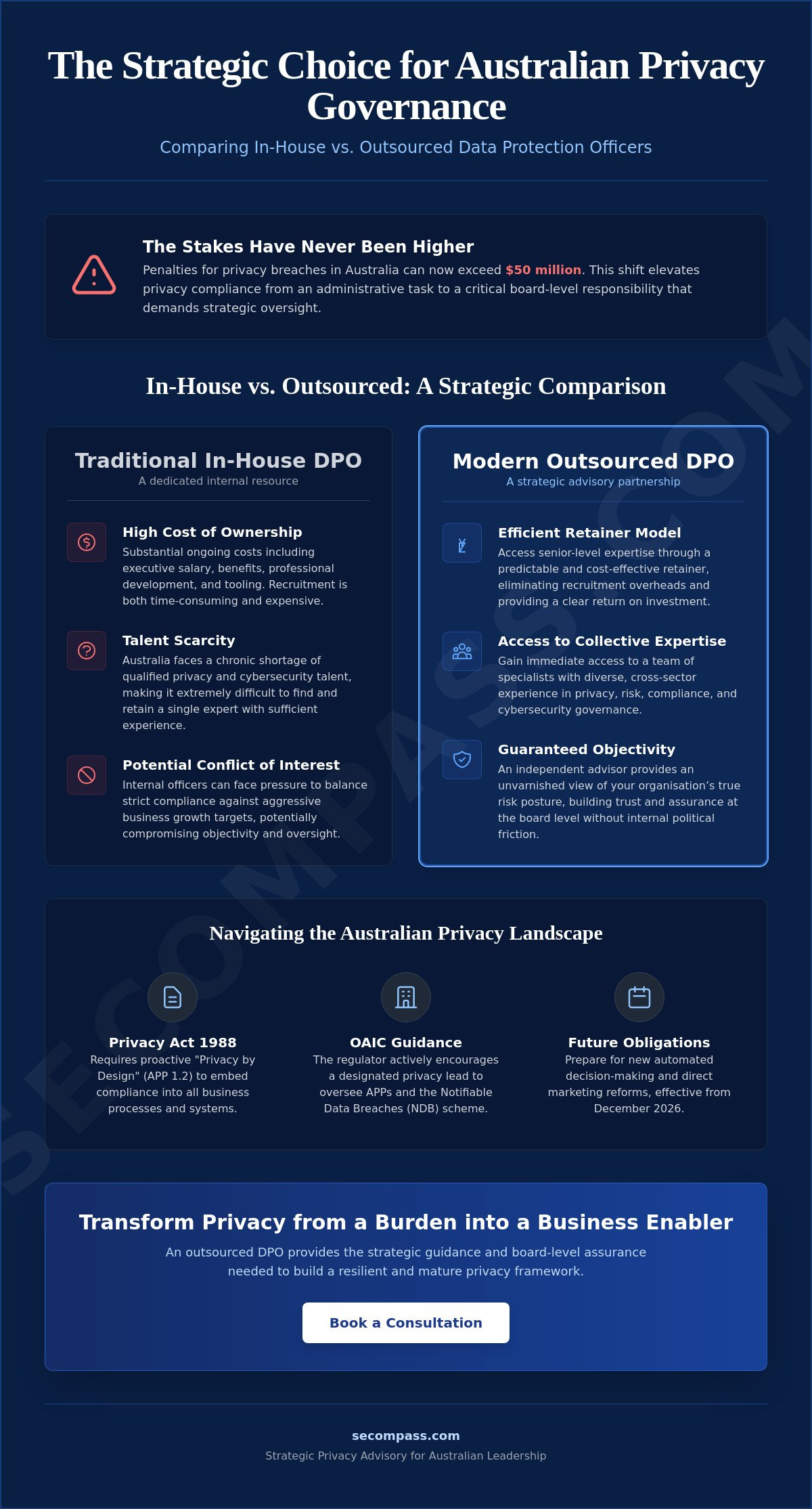
Deciding between a permanent hire and a consultative partnership is a pivotal choice for any leadership team. While an internal lead provides dedicated focus, an outsourced data protection officer australia offers a level of objectivity that is difficult to replicate within a corporate hierarchy. This third-party perspective ensures that internal data practices are evaluated without the bias of internal performance indicators or departmental pressures. The independence of an outsourced advisor is critical for maintaining board-level trust because it provides an unvarnished view of the organisation's actual risk posture.
The Australian market currently faces a significant shortage of qualified privacy and cybersecurity talent. This scarcity makes recruiting and retaining an in-house expert both time-consuming and expensive. By choosing an outsourced model, organisations bypass these recruitment hurdles and gain immediate access to a broader collective of expertise. This depth of knowledge allows for more sophisticated responses to complex privacy impact assessments and emerging regulatory challenges.
Objectivity and Strategic Integrity
Internal privacy officers often find themselves caught between aggressive business growth targets and strict privacy constraints. This conflict can lead to compromised oversight or friction within the executive team. By contrast, an outsourced advisor maintains strict independence, acting as a steady hand that prioritises long-term systemic integrity. Many organisations are now adopting Privacy as a Service (PaaS) to access scalable leadership that evolves alongside their operations. This model ensures that as your data footprint expands, your privacy maturity keeps pace without the friction of internal politics.
Cost Efficiency and Resource Allocation
The total cost of ownership for a full-time executive can be substantial when accounting for salary, benefits, and ongoing professional development. A strategic retainer model provides a more predictable and often more efficient alternative. This approach provides access to specialists who bring experience from multiple sectors, which is invaluable when interpreting the Australian Privacy Principles (APPs). It allows your internal teams to focus on core product innovation while the DPO manages the underlying compliance framework. If you are weighing these options for your leadership team, you may wish to discuss your privacy maturity journey with a specialist.
Integrating an Outsourced DPO into Your Governance Strategy
Successful integration of a new advisory function requires a methodical and logical approach. For an outsourced data protection officer australia to be truly effective, the partnership must begin with a comprehensive privacy gap analysis. This initial assessment establishes a current maturity baseline, which allows the executive team to prioritise remediation efforts based on actual risk rather than perceived threats. SeComPass facilitates this transition through a structured advisory programme that provides the necessary scaffolding for long-term maturity and regulatory alignment.
The DPO should never operate as a siloed vendor. Instead, they must function as a seamless extension of your leadership team, participating in strategic risk discussions and providing the board with regular, actionable reporting. This constant flow of information ensures that privacy remains a central pillar of your broader corporate governance framework. It fosters a culture where data protection is recognised as a shared responsibility and a business enabler rather than a technical hurdle.
The SeComPass Approach to Privacy Leadership
Our methodology focuses on tangible business outcomes, ensuring that privacy controls support operational resilience rather than creating administrative bottlenecks. We specialise in integrating privacy requirements with existing security frameworks, such as ISO 27001 or SOC 2, to create a unified assurance posture. This holistic view satisfies both regulators and sophisticated clients who demand high standards of data integrity. You can discover our Virtual CISO services for integrated security leadership to see how we align these critical functions across your organisation.
Commencing Your Privacy Maturity Journey
The first 90 days are focused on establishing the privacy management framework and identifying your organisation's most critical data assets. This period is vital for building trust and ensuring that stakeholders understand their role in the new governance model. Beyond the initial setup, we provide ongoing stewardship through continuous monitoring of the Australian regulatory environment. This proactive adjustment of internal policies ensures your organisation remains ahead of legislative shifts. For further insights on high-level oversight, you may wish to read about strategic security leadership and assurance.
Securing Your Organisation's Privacy Maturity
Establishing a resilient privacy framework requires more than just technical compliance. It demands strategic oversight that aligns with your broader business objectives. By engaging an outsourced data protection officer australia, your leadership team gains the objective maturity needed to navigate complex regulatory reforms while maintaining a focus on growth. This partnership ensures that your organisation remains adaptable and prepared for future legislative shifts, such as the upcoming transparency requirements for automated decision-making.
SeComPass provides this strategic support through our offices in Melbourne and Auckland, offering the local context and deep expertise across ISO 27001, SOC 2, and NIST frameworks. Our model is designed to function as an extension of your executive team, prioritising business enablement and operational resilience over simple administrative checklists. We invite you to discuss your privacy maturity journey with our experts and discover how a structured advisory programme can strengthen your governance posture. Moving forward with a clear strategy will provide the board-level assurance your organisation requires for long-term stability.
Frequently Asked Questions
Is an outsourced Data Protection Officer legally required in Australia?
The Australian Privacy Act 1988 does not explicitly mandate the appointment of a "Data Protection Officer" by that specific title. However, the Office of the Australian Information Commissioner (OAIC) strongly encourages organisations to appoint a designated privacy lead to manage compliance with the Australian Privacy Principles. Appointing a lead ensures clear accountability and provides a central point of contact for regulatory enquiries and internal strategy.
What is the difference between a Privacy Officer and a Data Protection Officer?
A Privacy Officer is typically an internal role focused on day to day administrative compliance and policy management within a business. In contrast, an outsourced data protection officer australia provides a more strategic and independent oversight function. While the roles overlap, a DPO often carries broader responsibilities for systemic integrity and reporting directly to the board, mirroring the high level governance requirements found in international frameworks.
Can an outsourced DPO handle Notifiable Data Breaches?
Yes, an outsourced DPO is specifically equipped to manage the complexities of the Notifiable Data Breaches (NDB) scheme. They lead the assessment process to determine if a breach is likely to result in serious harm and advise on the necessary notification steps for both the OAIC and affected individuals. This independent oversight ensures that your response is methodical, transparent, and compliant with the strict statutory timeframes required by Australian law.
How does an outsourced DPO ensure independence?
An outsourced data protection officer australia ensures independence by operating as a third party advisor without the internal conflicts of interest that can affect permanent staff. They are not tied to departmental performance targets or internal product deadlines, which allows them to provide an unvarnished assessment of privacy risks. This objective position is essential for providing the board with genuine assurance regarding the organisation's actual compliance posture and risk reduction efforts.

Article by
Jatinder Oberoi
Founder and Principal Consultant at SeComPass, a cybersecurity, privacy, governance, and compliance advisory firm supporting organisations across Australia and New Zealand. With extensive experience in cybersecurity leadership, risk management, ISO 27001, SOC 2, privacy, and governance advisory, he works closely with executive teams to help organisations strengthen operational resilience and improve cybersecurity maturity. Known for his pragmatic and business-focused approach, Jatinder specialises in translating complex cybersecurity and compliance challenges into clear, actionable strategies for leadership teams. His work focuses on helping organisations align security initiatives with business objectives, governance expectations, regulatory obligations, and long-term resilience outcomes. Through SeComPass, he regularly advises organisations on cybersecurity governance, AI risk, third-party risk, compliance frameworks, security leadership, and enterprise resilience. His writing and advisory approach emphasises clarity, practical decision-making, and sustainable security maturity over fear-driven cybersecurity messaging.